Blog

Explore expert tips and tricks to maximize your platform usage.
Thank you! Your submission has been received!
Oops! Something went wrong while submitting the form.
GetHookd Ads Library vs Facebook Ads Library
Gethookd vs Meta Ads Library
-
April 4, 2026

Roofing Facebook Ads: Examples & Tips

Key Takeaways

  • Facebook ads work for roofing companies because they allow hyper-local targeting, which lets you concentrate ad spend on the exact neighborhoods you serve.
  • Four Facebook ad formats dominate roofing campaigns: image ads, video ads, carousel ads, and lead ads, with each serving a different stage of the buyer journey.
  • The highest-converting roofing ads lead with a specific homeowner pain point, such as storm damage, aging shingles, or a seasonal inspection offer, rather than a generic service statement.
  • Run at least three to four creative variations simultaneously and let performance data determine the winner before scaling spend.
  • Use GetHookd to identify which roofing ad formats are already converting in your market, then use our AI-powered creative tools to replicate and adapt winning concepts before spending a dollar on production.

Roofing Facebook Ads That Actually Win Jobs

Roofing is a high-ticket, low-frequency purchase, which means your Facebook ads need to catch homeowners at exactly the right moment or create enough urgency to make them act now.

The roofing Facebook ads that win jobs meet homeowners where they are emotionally. That could be after a hailstorm, before winter, or when a roof is pushing 20 years old. Facebook's targeting tools make this kind of precision possible, but the creative still has to earn the click. 

Trust is the primary barrier in roofing. Homeowners are skeptical of contractors, and an ad that leads with social proof, before and after visuals, or a reference to a recent local weather event will consistently outperform a generic pitch.

In this guide, learn the 4 Facebook ad formats that actually win jobs (image ads, video ads, carousel ads, and lead ads), real examples of winning roofing ads, and tips to improve your Facebook ads. 

GetHookd: Turn Competitor Intelligence Into Your Next Winning Ad

65M+ Ads Analyzed | 4.8★ G2 Rating | 4.5★ Trustpilot Rating

Stop Guessing. Start Scaling:

GetHookd reveals which ads your competitors are actively scaling—not just running. Spy on their best-performing creatives, landing pages, and traffic strategies, then turn proven concepts into testable campaigns in seconds with AI-powered script generation and creative cloning.

What You Get:
  • ✓ Brand Spy to decode competitor ad strategies in real-time
  • ✓ AI script generation and ad cloning for instant variations
  • ✓ Performance scoring based on actual ad behavior, not vanity metrics
  • ✓ Creative Analyzer to identify and scale your top performers
Replace guesswork with intelligence. Build profitable ads that actually convert.

Best Roofing Facebook Ad Formats You Should Know

Facebook offers several ad formats, and each serves a different purpose in your roofing marketing funnel. Choosing the wrong format for your goal is one of the most common reasons roofing ads underperform.

Image Ads
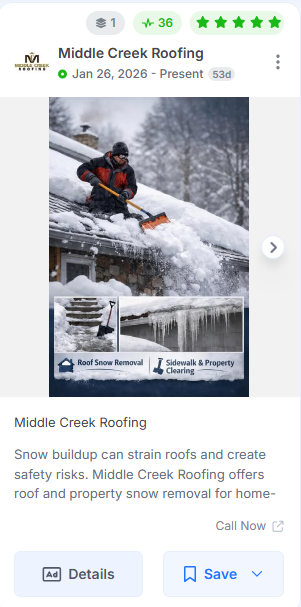
A roofing company using a seasonal, relevant image to address a specific homeowner pain point. (Source: GetHookd)

Image ads are the simplest format and often the most underestimated. A single high-quality photo of a completed roof replacement, ideally a before-and-after, paired with a sharp headline and a clear call to action, can outperform more elaborate productions. 

The key is using a real project photo rather than stock imagery. Homeowners can tell the difference instantly, and authenticity builds trust before they have read a single word of your copy.

Video Ads
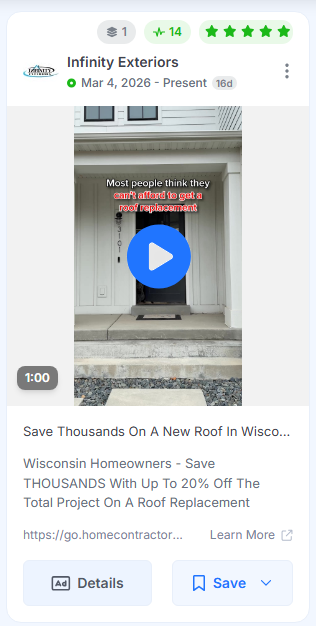
Video ads let roofing companies show the transformation, build trust, and present an offer all within a single minute of screen time.  (Source: GetHookd)

Video ads consistently drive higher engagement than static images, and for roofing companies, they offer a distinct advantage: you can show the transformation in real time. 

A 30- to 60-second time-lapse of a full roof replacement, with text overlays highlighting materials used, project timeline, and a closing CTA, is one of the highest-converting formats in roofing advertising. 

You do not need a production crew. A smartphone mounted on a tripod, combined with basic editing tools, can produce professional-looking content.

Carousel Ads
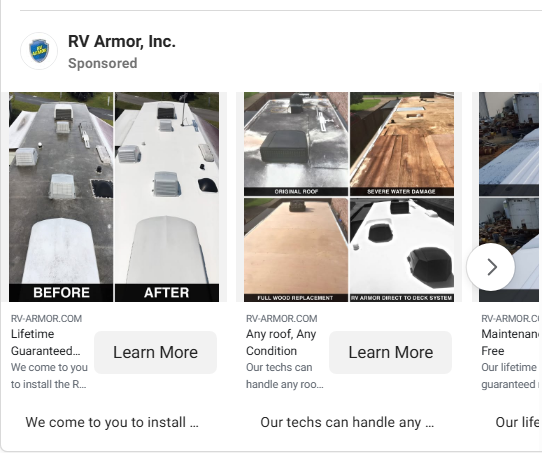
A carousel ad lets roofing companies showcase multiple projects, services, and proof points in a single swipeable format. (Source: Meta Ad Library)

Carousel ads display multiple images or videos within a single ad unit. Roofing companies can use each card to showcase a different completed project, a different service, or a step-by-step breakdown of their process. 

This format also gives the algorithm more engagement data to work with, which feeds directly into future campaign decisions.

Lead Ads

Instead of sending users to a landing page, lead ads open a pre-filled form within Facebook that pulls the user's name, email, and phone number automatically from their profile. 

The friction is minimal, which means more submissions and a lower cost per lead. The best roofing lead ads pair a compelling offer, such as a free roof inspection or storm damage assessment, with a short form that asks only for the essentials. 

Adding a qualifying question like "Is your roof more than 15 years old?" helps filter leads and gives your sales team better context before the follow-up call.

Real Roofing Facebook Ad Examples That Generate Leads

Storm Damage Emergency Response Ads
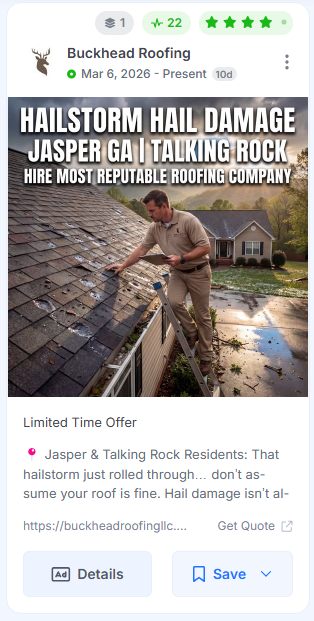
Storm damage ads perform best when they are hyper-local, timely, and lead with the homeowner's situation. (Source: GetHookd)

When a hailstorm or wind event hits your service area, the window to capture leads is narrow. The most effective storm damage ads lead with urgency rather than a sales pitch.

You can pair a headline like "Did the Storm Hit Your Roof Last Night?" with a real damage photo and a free inspection offer. Roofing companies that launch within 24 to 48 hours using location targeting focused on affected zip codes consistently outperform competitors who wait.

Seasonal Roof Inspection Ads

Spring and fall are the most receptive windows for roofing inspection outreach. A well-timed seasonal ad positions your company as helpful rather than opportunistic. 

A clean image of a roof in good condition, paired with a headline like "Is Your Roof Ready for Winter? Free Inspection This Month Only," works well for this format.

Keep the copy brief and benefit-focused, and use a specific CTA. "Book My Free Inspection" converts better than generic phrases like "Learn More" or "Contact Us."

Customer Testimonial Ads

Trust is the biggest barrier between a roofing ad and a booked job. Testimonial ads solve this by letting past clients do the selling. 

The most effective format combines a short video testimonial, even 20 to 30 seconds recorded on a customer's phone, with a photo of their completed roof. If the video is not available, a text-based testimonial overlay on a before-and-after image works well.

Free Estimate Offer Ads
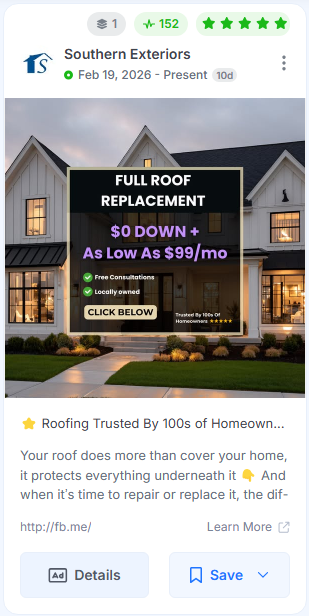
A free estimate ad removes every barrier between the homeowner and the next step. (Source: GetHookd)

The free estimate ad still works because the value proposition is clear. Homeowners have nothing to lose, which removes the biggest hesitation in responding to an ad from a company they do not know. 

Pair the offer with a visual of a crew member conducting a professional inspection and copy that reinforces credibility through years in business, the number of roofs completed, or a local license number.

Social Proof & Review-Based Ads
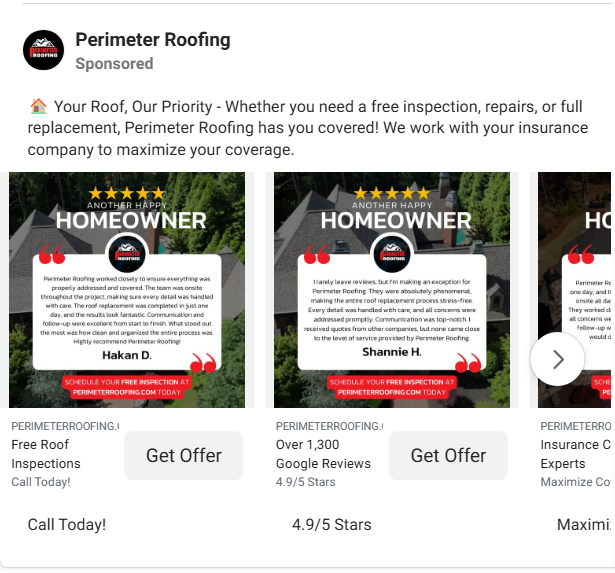
Leading with real customer testimonials gives roofing ads the social proof that no headline or tagline can replicate. (Source: Meta Ad Library)

Most roofing companies underutilize their reviews in paid advertising. A review-based ad that leads with a 5-star rating, a one-sentence pull quote, and a photo of the completed project consistently builds the credibility that generic roofing ads cannot. 

A headline like "Rated 4.9 Stars by 312 Homeowners in [Your City]" reinforces the social proof before the homeowner reads a single line of copy. These ads work particularly well for retargeting, where a wall of five-star reviews is often the final nudge a homeowner needs to pick up the phone.

Tips to Get More From Your Roofing Facebook Ad Budget

Lead With the Problem, Not the Service

The highest-converting roofing ads open by naming a specific problem the homeowner is experiencing. That shift from service provider to problem solver drives click-through rates up and cost-per-lead down.

Monitor Competitors' Strategies

An ad running for several weeks without changes is almost certainly performing well, which tells you exactly what is resonating with the audience you share.

GetHookd's Explore Ads and Brand Spy surface which ads competitors are actively scaling across Meta, the landing pages behind their top performers, and how their creative direction shifts over time. 

The Creative Analyzer then helps you apply those same signals to your own ads, identifying which creatives are worth scaling before you increase spend. This gives you competitive intelligence that the native Ad Library does not provide.

Test Multiple Ad Creatives Before Scaling Spend

Never put your full budget behind a single creative. Run at least three to four variations simultaneously, differing in image or video, headline, and primary text, and let them run with equal budget for the first seven to ten days before allocating more spend toward the winner.

Use Hyper-Local Targeting to Your Advantage

Roofing is one of the most location-dependent businesses on Facebook. Targeting by zip code rather than a broad radius lets you focus ad spend on the neighborhoods where your brand may already have some recognition. 

Referencing a specific city, neighborhood, or recent local weather event in your ad copy makes the creative feel personal, which directly improves click-through rates and lead quality.

Run Smarter Roofing Facebook Ads With GetHookd

The roofing companies generating consistent leads from Facebook are not guessing at what to run, and neither are the agencies managing their campaigns. Our Explore Ads feature gives you access to 65M+ Meta ads searchable by niche and performance signals, so you can identify which formats, hooks, and offers are converting for roofing companies in your area right now. Brand Spy shows exactly which ads competitors are actively running, giving you the competitive context to brief smarter creative from the start.

For production, our Video Scripts tool generates conversion-focused scripts from your service details, Clone Ads produces multiple static ad variations, and Ads Transcription breaks down any competitor video ad into its hook and copy structure. Our Creative Analyzer identifies which of your existing roofing ads are worth scaling before you commit more budget.

Start your GetHookd free trial today.

Frequently Asked Questions (FAQs)

How much should a roofing company spend on Facebook ads?

Most local roofing companies start with a daily budget between $20 and $50, scaling up once they have identified which creatives and audiences are converting. Start conservative, let campaigns run for at least seven to ten days before making major adjustments, and increase spend incrementally as cost-per-lead stabilizes.

What is the best Facebook ad objective for a roofing business?

The Leads objective is the strongest starting point for roofing companies focused on direct inquiries. It optimizes delivery toward users most likely to submit a form and keeps friction minimal by auto-populating contact details from their Facebook profile.

How do I target homeowners with Facebook ads?

Facebook removed homeowner as a specific targeting category in 2022, so the most effective approach is geographic targeting by zip code or a defined radius around your service area, combined with broad demographic parameters and interest signals relevant to home improvement.

How long does it take for roofing Facebook ads to generate leads?

Most roofing campaigns begin delivering leads within the first three to seven days, but the first two weeks should be treated as a learning phase rather than a performance benchmark. Facebook's algorithm needs approximately 50 conversion events per ad set before it fully optimizes, so avoid making major creative or budget changes during that window.

Can GetHookd help me find high-performing roofing Facebook ads?

Yes. GetHookd’s Explore Ads lets you search Meta's ad database by niche and performance signals, so you can study which roofing ad formats, hooks, and offers are actively converting before you brief a single creative. Brand Spy shows which specific ads your competitors are scaling and where their traffic lands, giving you a competitive picture that the native Meta Ad Library does not provide.

*Note: Pricing and/or product availability mentioned in this post are subject to change. Please check our website for current pricing and stock information before making a purchase.
GetHookd Ads Library vs Facebook Ads Library
Gethookd vs Meta Ads Library
-
April 2, 2026

Plumber Facebook Ads: Examples & Tips

Key Takeaways

  • Facebook ads work best for plumbers when they focus on the customer's problem first.
  • Retargeting website visitors is one of the highest-converting strategies available to local plumbing businesses on Facebook.
  • Video ads, testimonial ads, and lead-generation ads are formats that consistently outperform others in the home services space.
  • Most people don't go to Facebook during a plumbing emergency, so your strategy should focus on brand awareness and staying top-of-mind until they need you.
  • Use GetHookd's 65M+ Meta ads database to see what plumbing ads are already converting in your market, then use our AI creative tools to produce and launch your own in minutes.

The Right Facebook Ads Can Fill Your Schedule With Leads

Facebook has over 3 billion monthly active users, and a significant portion of them are homeowners in your service area who will need a plumber at some point. The question is whether they will think of you when something goes wrong.

That's the real job of a plumber Facebook ad. It's not to get someone to book an emergency repair while they're scrolling through their feed. It's to build enough familiarity and trust that when a pipe bursts at 11 pm, your name is the first one they search for.

This is a fundamentally different mindset than Google Ads, where you're capturing demand that already exists. Facebook is about creating awareness and building trust before the need arises. When you understand that distinction, everything about how you create your ads changes.

GetHookd: Turn Competitor Intelligence Into Your Next Winning Ad

65M+ Ads Analyzed | 4.8★ G2 Rating | 4.5★ Trustpilot Rating

Stop Guessing. Start Scaling:

GetHookd reveals which ads your competitors are actively scaling—not just running. Spy on their best-performing creatives, landing pages, and traffic strategies, then turn proven concepts into testable campaigns in seconds with AI-powered script generation and creative cloning.

What You Get:
  • ✓ Brand Spy to decode competitor ad strategies in real-time
  • ✓ AI script generation and ad cloning for instant variations
  • ✓ Performance scoring based on actual ad behavior, not vanity metrics
  • ✓ Creative Analyzer to identify and scale your top performers
Replace guesswork with intelligence. Build profitable ads that actually convert.

Real Plumber Facebook Ad Examples That Work

1. The Trust-Builder Ad: Reviews & Free Inspections

This is one of the most effective formats for cold audiences who have never heard of your business. Lead with a strong customer review, pair it with a low-commitment offer like a free inspection or discounted drain cleaning, and make your contact information easy to find. 

A specific review answers the trust question, and a clear offer gives the homeowner a reason to act, which is the combination that stops the scroll.

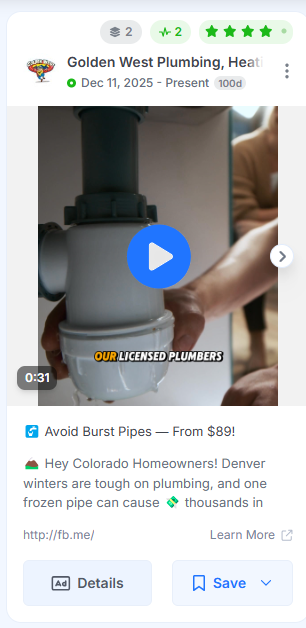
2. The Video Ad: Short, Engaging, & Location-Specific

Golden West Plumbing opens with a direct callout to Colorado homeowners and a seasonal problem they recognize. (Source: GetHookd)

Video consistently outperforms static images on Facebook for engagement. The most effective plumber video ads are under 60 seconds, feature a real technician or job site, and open with a location-specific hook in the first three seconds. 

An immediate local reference signals relevance to the viewer and reduces the likelihood they scroll past before the offer lands.

3. The Testimonial Ad: Let Customers Sell For You

A testimonial ad takes social proof further than a written review by featuring a short video or photo of a real customer describing a specific problem your team solved. 

The authenticity of a real person on camera builds trust faster than any headline you could write, and it works equally well as a standalone cold campaign or layered into a retargeting sequence.

4. The Informational Video Ad: Build a Retargeting List

Run a short, genuinely useful video such as "3 Signs Your Water Heater Is About to Fail" as a Facebook ad targeting local homeowners. Anyone who watches 50% or more gets added to a custom retargeting audience automatically, giving you a warm pool of local homeowners who already recognize your brand. 

Your follow-up ad with a direct offer then hits people who are already familiar with your business, which consistently produces a lower cost per lead than running a direct offer to a cold audience from the start.

5. Seasonal Promotion Ad

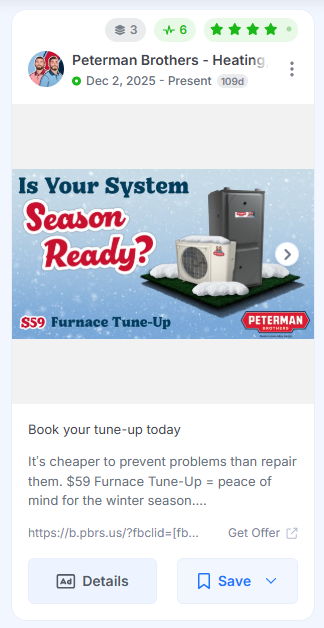
Peterman Brothers leads with a seasonal question and anchors the offer to a price, giving homeowners a clear reason to book before winter hits. (Source: GetHookd)

Plumbing demand shifts with the seasons, and a well-timed promotion ad captures homeowners during the consideration window before a problem becomes urgent. A winter pipe protection offer ahead of a cold snap or a spring drain cleaning promotion at the start of heavy rain season reaches homeowners when the need feels relevant rather than hypothetical. 

Lead with a specific, time-limited offer and pair it with a lead form so homeowners can book without leaving Facebook. Seasonal ads also serve as a natural entry point for upsells, since a homeowner who books a maintenance visit is far more likely to approve additional work from a technician already in their home.

5 Tips for Writing Plumber Facebook Ad Copy That Converts

1. Lead With the Customer's Problem

The fastest way to get a homeowner to stop scrolling is to describe their exact problem back to them. Open your ad with something like "Is your water bill mysteriously creeping up every month?" or "Low water pressure driving you crazy?" 

That immediate recognition makes the reader feel like the ad was written specifically for them. This approach works because it shifts the focus from your company to the customer's experience. 

Nobody on Facebook is looking for a plumber to brag at them. They want to know that someone understands their frustration and has a solution.

2. Keep Your Message Short & Jargon-Free

Long paragraphs packed with technical plumbing terminology will lose people immediately, even the ones who genuinely need your services. The most effective plumber Facebook ads follow a tight structure that respects the reader's time and attention span. 

Here is a format that works reliably:

  • Line 1: Hook that names the problem (one sentence)
  • Line 2: Your solution or offer (one sentence)
  • Line 3: Social proof, a quick stat or review snippet
  • Line 4: Clear call to action with your phone number or booking link

Write like you're texting a neighbor, not filing a report. If a 12-year-old couldn't read your ad and understand it in under 10 seconds, it needs to be simplified. 

Swap out words like "hydro-jetting remediation" for "drain cleaning" and "pressure regulation valve replacement" for "fixing low water pressure." The goal is to get someone to pick up the phone and call you.

3. Include a Clear Offer or Call to Action

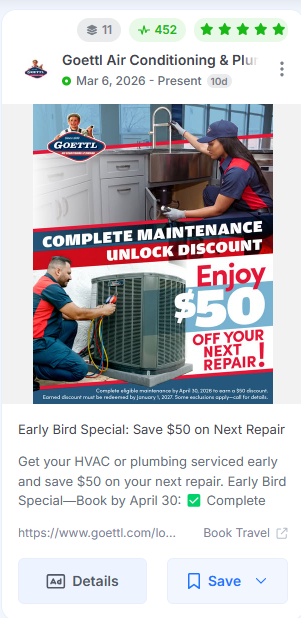
Goettl pairs a maintenance discount with a hard deadline, giving homeowners a clear offer and a reason to act before the offer expires. (Source: GetHookd)

Every high-performing plumber Facebook ad has one thing in common: it tells the reader exactly what to do next. Whether that's "Call now for a free estimate," "Book online in 60 seconds," or "Claim your $49 drain cleaning special," the next step must be crystal clear.

Vague CTAs like "Learn More" or "Contact Us" underperform every time compared to specific, action-oriented language.

A strong offer also dramatically increases your ad's effectiveness. Free inspections, first-time customer discounts, and seasonal promotions like "Winter Pipe Check at $0 for the month of January" give people a concrete reason to act now rather than saving your number for later and forgetting about it entirely.

4. Use Human Images or Video to Build Connection

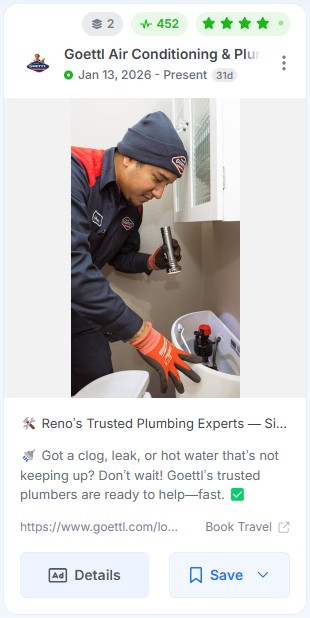
Goettl puts a human face on the brand before the offer is even read. (Source: GetHookd)

Stock photos of pipes and wrenches don't stop anyone from scrolling. Real photos of your actual technicians, in uniform, on a job site, smiling at the camera, perform significantly better because they put a human face on your business. 

People hire people, not companies. When someone sees a friendly, professional-looking plumber in your ad, it immediately reduces the anxiety of letting a stranger into your home.

5. Use Retargeting Ads for Website Visitors

The majority of plumbing Facebook ad campaigns that produce consistent, cost-effective leads are built on retargeting, specifically targeting people who have already visited your website. 

By installing the Meta Pixel on your plumbing website, Facebook can track visitors and serve your ads specifically to those people as they scroll through their feed later. These are warm leads who already showed enough interest to check you out, which is exactly why retargeting audiences convert at a significantly higher rate than cold traffic audiences.

Build Plumber Facebook Ads That Convert With GetHookd

Our Explore Ads and Brand Spy tools give you access to a database of 65M+ Meta ads, so you can see exactly what plumbing companies near you are running on Facebook right now and which ones are getting real traction. That kind of pre-spend intelligence removes the guesswork that drains ad budgets and gives you a foundation to build campaigns informed by what the target audience is already responding to.

From there, our AI-powered creative tools help you move from research to live ads fast. You can write video scripts tailored to your offer, clone winning ads in seconds, analyse and remix top-performing image creatives, and generate image ads using templates built to drive conversions, all without a designer or a production budget.

Start your free trial and run smarter plumber Facebook ads today.

Frequently Asked Questions (FAQs)

How to advertise as a plumber? 

The most effective approach for local plumbing advertising is Facebook ads for awareness and trust-building, supported by a steady stream of Google reviews to close the credibility gap when someone is comparing options. 

Facebook works best when your creative leads with a real face, a specific local reference, and an offer that removes friction from the first step.

What is the best type of Facebook ad for a plumbing business? 

The right format depends on where the homeowner is in their decision-making process. Video and trust-building ads work best for cold audiences, retargeting ads with a direct offer work best for warm audiences, and lead form ads work well for existing customers. 

If you are just getting started, a simple image ad with a strong offer and a real photo of your team is the lowest-barrier format to launch and generate leads quickly.

Should plumbers use video in their Facebook ads? 

Video is one of the highest-performing formats for plumbing businesses on Facebook because it builds trust quickly and populates your retargeting audiences automatically. Every person who watches a meaningful portion of your video gets added to a custom audience you can follow up with using a direct offer. 

A 30-second phone video of a technician explaining a common plumbing problem is enough to outperform more polished, generic creatives.

How do plumbers target the right audience on Facebook? 

Start targeting around your actual service area, filter for homeowners aged 30 to 65, and install the Meta Pixel on your website before running any ads so retargeting is active from day one. 

Once you have at least 100 existing customers in a list, upload it to Facebook to create a Lookalike Audience that finds people who share the same characteristics as your best customers. Keep your geographic radius tight until you have performance data to justify expanding it.

Can Facebook ads work for emergency plumbing services? 

Facebook is not the right tool for capturing emergency leads in real time since homeowners with an active plumbing crisis go to Google first. Where Facebook works for emergency services is in the weeks and months before an emergency happens, building enough brand recognition that your name is already familiar when a pipe bursts and they need someone fast. 

Use GetHookd's Explore Ads to study how other plumbing companies in your market position their emergency messaging and identify gaps your campaigns can fill.

*Note: Pricing and/or product availability mentioned in this post are subject to change. Please check our website for current pricing and stock information before making a purchase.
GetHookd Ads Library vs Facebook Ads Library
Gethookd vs Meta Ads Library
-
April 1, 2026

AdSpyder Pricing, Reviews & Alternatives: Is This Ads Spy Tool Worth It?

Key Takeaways

  • AdSpyder is a low-cost, multi-platform ad spy tool. Starting at $10/month, it covers 9+ platforms and offers solid value for basic ad research.
  • AdSpyder combines ad spying, AI generation, and analytics, but works best when paired with active campaign testing.
  • User feedback for AdSpyder is mixed. Strong G2 ratings highlight features, while lower Trustpilot scores raise concerns about billing and support.
  • AdSpyder alternatives like GetHookd, PowerAdSpy, and BigSpy can offer greater reliability or more advanced features, depending on your needs.
  • GetHookd combines Meta ad intelligence with AI creative tools to help brands reduce guesswork, scale faster, and spend less on ad testing.

Is AdSpyder Worth It?

AdSpyder starts at $10/month and covers 9+ ad platforms, including Google, Meta, YouTube, and TikTok. AdSpyder is worth considering if you need broad multi-platform ad research at a low entry cost. However, a 3.8/5 Trustpilot score alongside a 4.9/5 G2 rating suggest the experience is uneven, and several user complaints about billing and support are worth noting before you commit.

The platform sits across three tiers ($10, $20, and $30/month), each backed by a 7-day free trial with no credit card required. Features range from basic ad spying to AI-generated ads, landing page analysis, and automated competitor tracking. 

This article breaks down each pricing plan, what real users say, and three alternatives: GetHookd, PowerAdSpy, and BigSpy, so you can decide which tool actually fits your workflow.

GetHookd: Turn Competitor Intelligence Into Your Next Winning Ad

65M+ Ads Analyzed | 4.8★ G2 Rating | 4.5★ Trustpilot Rating

Stop Guessing. Start Scaling:

GetHookd reveals which ads your competitors are actively scaling—not just running. Spy on their best-performing creatives, landing pages, and traffic strategies, then turn proven concepts into testable campaigns in seconds with AI-powered script generation and creative cloning.

What You Get:
  • ✓ Brand Spy to decode competitor ad strategies in real-time
  • ✓ AI script generation and ad cloning for instant variations
  • ✓ Performance scoring based on actual ad behavior, not vanity metrics
  • ✓ Creative Analyzer to identify and scale your top performers
Replace guesswork with intelligence. Build profitable ads that actually convert.

What Is AdSpyder?

AdSpyder is an ad intelligence platform that combines competitive ad research, performance analytics, and AI-powered ad generation into a single tool. Its ad library spans 15+ platforms across 100+ countries, and its features extend beyond passive research to include text, image, and video ad generation, domain analysis, and landing page insights.

The platform also includes AI Agents for tasks such as campaign optimisation, keyword analysis, and ad discovery. Agentic Mode is available on the All-in-One plan. A Chrome extension rated 4.3/5 on the Chrome Web Store gives users quick access to domain and ad analysis directly from their browser. The platform is primarily suited to agencies, D2C brands, freelancers, and affiliate marketers who want centralized competitive intelligence across multiple ad networks.

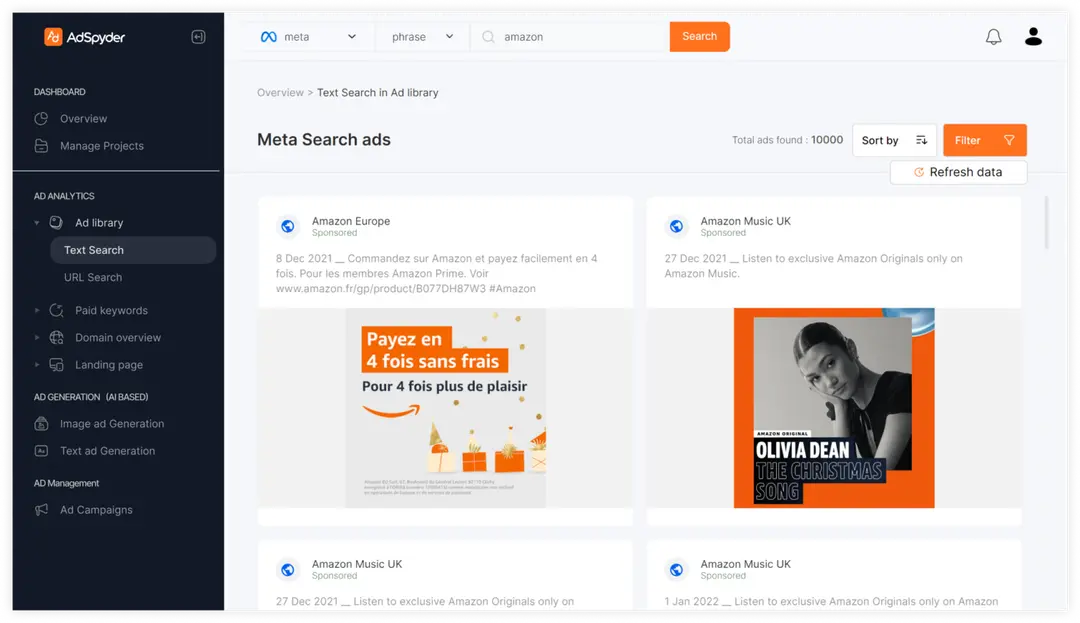
The AdSpyder dashboard displays its ad library and competitive research tools, covering 9+ ad platforms across 100+ countries for marketers and agencies. (Image source: AdSpyder)

AdSpyder Pricing Plans

AdSpyder currently offers three monthly subscription plans, all backed by a 7-day free trial with no credit card required.

Spy Plan ($10/Month)

The Spy plan is AdSpyder's entry-level option. It covers all 9+ ad platforms, including Google, Meta (Facebook and Instagram), LinkedIn, YouTube, Shopping, Bing, Amazon, Twitter, and TikTok. Users can export up to 1,000 ads and access domain analysis, keyword research, and both text and image ad generation. For advertisers who primarily need multi-platform ad browsing without heavy analytics, this tier provides solid base coverage at a low monthly cost.

Spy + Analytics + Generation ($20/Month)

The mid-tier plan adds landing page analysis and video ad generation to everything in the Spy plan. The export limit also increases to 5,000 ads. This makes it more useful for marketers who want to understand competitor funnels beyond the creative level and who need video ad creation as part of their workflow.

All-in-One ($30/Month)

The All-in-One plan removes export limits entirely and adds ad account integration, Auto Ad Discovery (Smart Scrape), Agentic Mode, and priority support. Smart Scrape is AdSpyder's automated competitor monitoring system, which finds and tracks competitor ads across platforms 24/7 without manual search input. This plan is built for agencies or performance teams who want a continuous competitive monitoring setup with minimal manual overhead.

AdSpyder Reviews: What Users Are Saying

On G2, AdSpyder holds a 4.9/5 rating based on verified user reviews. Reviewers highlight multi-platform ad research, strong keyword and region-based filtering, and domain-level ad analysis as particularly useful. Some note a learning curve for new users and that the platform's value is highest when paired with an actual testing framework rather than used as a passive browsing tool.

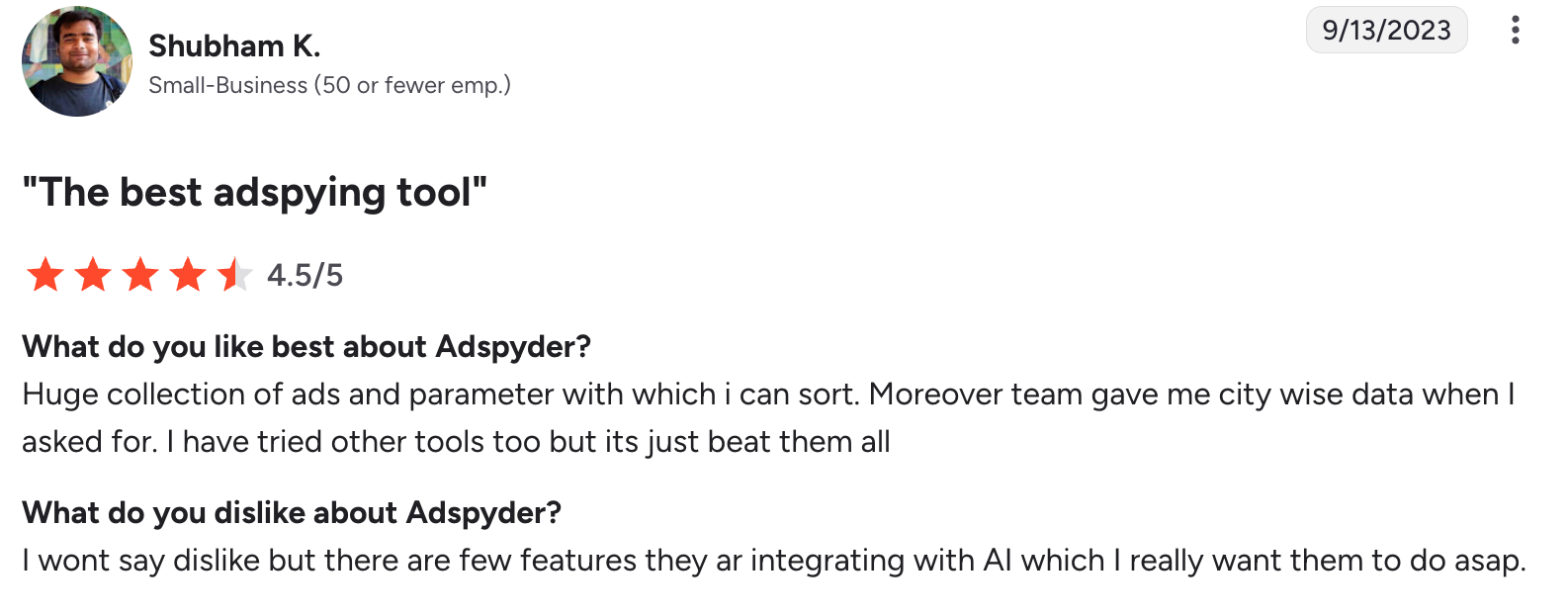
A small business user rates AdSpyder highly for its large ad database and granular sorting options, noting it outperforms other tools they've tested.

On Trustpilot, the score sits at 3.8/5. Positive feedback focuses on AI ad generation and the platform's ability to reduce research time. A portion of critical reviews references difficulties canceling trial subscriptions and slow customer support response times. 

The gap between the G2 and Trustpilot ratings is worth considering for anyone evaluating long-term use. AdSpyder's strength is clearly in competitive research, though the support and billing experience is less consistent.

3 AdSpyder Alternatives Worth Considering

1. GetHookd

GetHookd serves as a competitive ad research and creative intelligence platform, built specifically for media buyers and eCommerce teams focused on the Meta ad ecosystem.

GetHookd is a competitive ad research and creative intelligence platform built for media buyers, eCommerce teams, and agencies focused on Meta. Users get access to 65+ million high-performing Meta ads, combined with AI tools that take research from discovery through to testable creative.

Our Brand Spy feature surfaces the ads competitors are actively scaling with budget, rather than ads sitting passively live. This distinction is critical for performance marketers who need to know what is currently converting, not what ran six months ago. Users can save ads permanently even after campaigns go offline, transcribe video ads into hooks and scripts, and generate new ad image variations through AI Image Ads.

All plans include monthly credits that can be spent across features, including Brand Spy, Transcriptions, AI Scripts, AI Image Ads, and Creative Analyzer. This means these tools are available at every tier, not gated to higher plans. GetHookd's pricing starts at $19/month for the Launch plan (1 seat, 40 credits/month) and $59/month for the Grow plan (3 seats, 200 credits/month). All plans include a 7-day free trial.

On G2, our platform carries a 4.8/5 rating, with reviewers consistently noting how quickly they can move from ad research to testable campaigns and the practical value of AI-generated scripts and creative variations. On Trustpilot, GetHookd users highlight the ability to identify scaling trends early and the clean, fast interface as standout qualities.

A verified user praises GetHookd's per-brand ad limit feature and affordable entry plan as two practical advantages over competing ad intelligence tools.

2. PowerAdSpy

PowerAdSpy covers 10 ad networks, including Facebook, Google, YouTube, and LinkedIn, positioning itself as a multi-platform competitive intelligence tool for digital marketing teams. (Image source: PowerAdSpy)

PowerAdSpy is a multi-platform ad intelligence tool built around the breadth of platform coverage. It supports 10 social media and search networks, including Facebook, Instagram, Google, YouTube, LinkedIn, Pinterest, Reddit, Quora, Native ad networks, and Google Display Network.

Pricing starts at $69/month for the Basic plan, which includes access to Facebook, Instagram, Google, and YouTube. The Standard plan at $129/month adds Pinterest and LinkedIn, while the Premium plan at $179/month further adds TikTok. The Platinum plan at $279/month includes seven platforms: Facebook, Instagram, Google, YouTube, Pinterest, LinkedIn, and TikTok. A 3-day trial is available; $1 for the Basic plan and $7 for all other plans.

Key features across all plans include engagement-based ad sorting (by likes, comments, and shares), geo-targeted competitor analysis via Country Filter, call-to-action filtering, and ad bookmarking via Bookmark & Subscribe.

On Trustpilot, PowerAdSpy holds a 4.5/5 rating. Reviewers praise the multi-platform database, filtering options, and time saved on competitive analysis. Some users note that meaningful platform coverage is gated behind higher-tier plans and that occasional data freshness issues affect certain ad networks. Customer support quality also comes up as a recurring concern in some reviews.

3. BigSpy

BigSpy covers 10 social platforms and 40 eCommerce sites, offering one of the largest ad databases available, with entry pricing starting at $9 per month for Facebook and Instagram access. (Image source: BigSpy)

BigSpy is a broad-scope ad intelligence tool. It currently covers 9 platforms: Facebook, Instagram, YouTube, Twitter, AdMob, TikTok, Unity, Pinterest, and Yahoo, and spans 70+ countries and 23+ languages.

BigSpy offers five plans, which are Free, Basic, Pro, Group, and VIP Enterprise. The Free Plan is activated automatically upon registration and provides 5 daily queries and 20 ad saves, limited to Facebook. The Basic plan starts at $9/month, and the Pro plan is $99/month. A 3-day Pro trial is available for $1, with full access to Pro features.

BigSpy's low entry price is among the most affordable available, and its broad platform coverage is a key selling point. However, specific pricing for the Group plan and detailed per-plan feature breakdowns should be confirmed directly on the pricing page, as these details are dynamically rendered and not fully captured here.

On Trustpilot, BigSpy currently holds a 1.8/5 rating from about 24 reviews, with user complaints frequently citing billing issues, feature restrictions on lower plans, and inconsistent customer support. Reviews on Capterra and GetApp are notably more favorable, with users praising the ad database size and platform breadth, though pricing relative to feature access remains a common concern across both platforms.

Top AdSpyder Alternatives: Summary Table

Features GetHookd AdSpyder PowerAdSpy BigSpy
Starting Price $19/month $10/month $69/month Free / $9/month
Free Trial 7 days 7 days 3-day trial ($1–$7) Limited free plan
Platform Focus Meta (Facebook & Instagram) 9+ platforms 10 platforms 9 platforms
AI Creative Tools Scripts, cloning, image gen Text, image, video ad gen None None
Brand Spy / Competitor Tracking Yes Yes Yes Yes
Landing Page Analysis Yes Yes (mid + higher tiers) No No

How GetHookd Solves the Gaps in AdSpyder's Workflow

AdSpyder covers a wide range of platforms at a low entry price, but broad access is only useful if you can act on what you find. For performance marketers, dropshippers, and eCommerce brands who primarily run Meta ads, the real gap sits between spotting a winning ad and launching a tested variation of your own; research volume alone does not close it. That is exactly what GetHookd was built to close.

At GetHookd, our platform is purpose-built for teams actively running and spending on ads. Every feature connects competitive research to creative production in one place, so you are not stitching together insights from one tool and building creatives in another. If AdSpyder's multi-platform breadth is more than you need and a tighter Meta-focused workflow matters more, GetHookd is a better fit.

Start your GetHookd free trial today!

Frequently Asked Questions (FAQs)

What is AdSpyder?

AdSpyder is an ad intelligence and competitor research platform that lets marketers analyze ads across multiple channels like Google, Facebook, and display networks, uncover competitor strategies, and use AI tools to generate and optimize their own ad campaigns.

Is AdSpyder suitable for beginners?

AdSpyder is accessible for most skill levels. Its Chrome extension and 7-day free trial allow newcomers to test features before committing to a paid plan. That said, users unfamiliar with ad intelligence tools may need time to get the most from filtering options and analytics. The platform is better suited to marketers with some baseline knowledge of paid advertising.

What is the difference between brand spying and general ad research?

General ad research involves browsing ad libraries for broad inspiration. Brand spying focuses on a specific advertiser and tracks the ads they are actively running and scaling. Brand spying is more useful for decision-making because it shows you where a competitor is placing budget, not just what they have tested in the past.

How does GetHookd help teams cut wasted ad spend?

At GetHookd, we help performance marketers reduce wasted spend by replacing creative guesswork with structured intelligence. Our Brand Spy, AI script generator, Clone Ads, and Creative Analyzer give teams a repeatable path from competitive research to testable creative, reducing the number of failed tests and the time spent on manual research between campaigns.

*Note: Pricing and/or product availability mentioned in this post are subject to change. Please check our website for current pricing and stock information before making a purchase.
GetHookd Ads Library vs Facebook Ads Library
Gethookd vs Meta Ads Library
-
March 31, 2026

Swipekit Pricing, Reviews & Alternatives: Is This Ad Library Tool Worth It?

Key Takeaways

  • Swipekit is a budget-friendly ad research tool. Starting at $26/month, it lets you save, organize, and track competitor ads across major platforms.
  • Swipekit’s features, like Brand Tracker, AI script generation, and ad transcription, help speed up research and creative production.
  • While easy to use, recurring issues with login access and support can affect the overall Swipekit experience.
  • While Swipekit is affordable and efficient, alternatives like GetHookd, Foreplay, and MagicBrief offer deeper capabilities for larger campaigns.
  • GetHookd combines AI-powered competitor research, ad cloning, and script generation into one platform built for performance marketers scaling on Meta and the Facebook Ad Library.

Is Swipekit Worth It for Ad Research?

Swipekit is worth it for basic ad research, but it may fall short for teams that need deeper analytics and scaling tools.

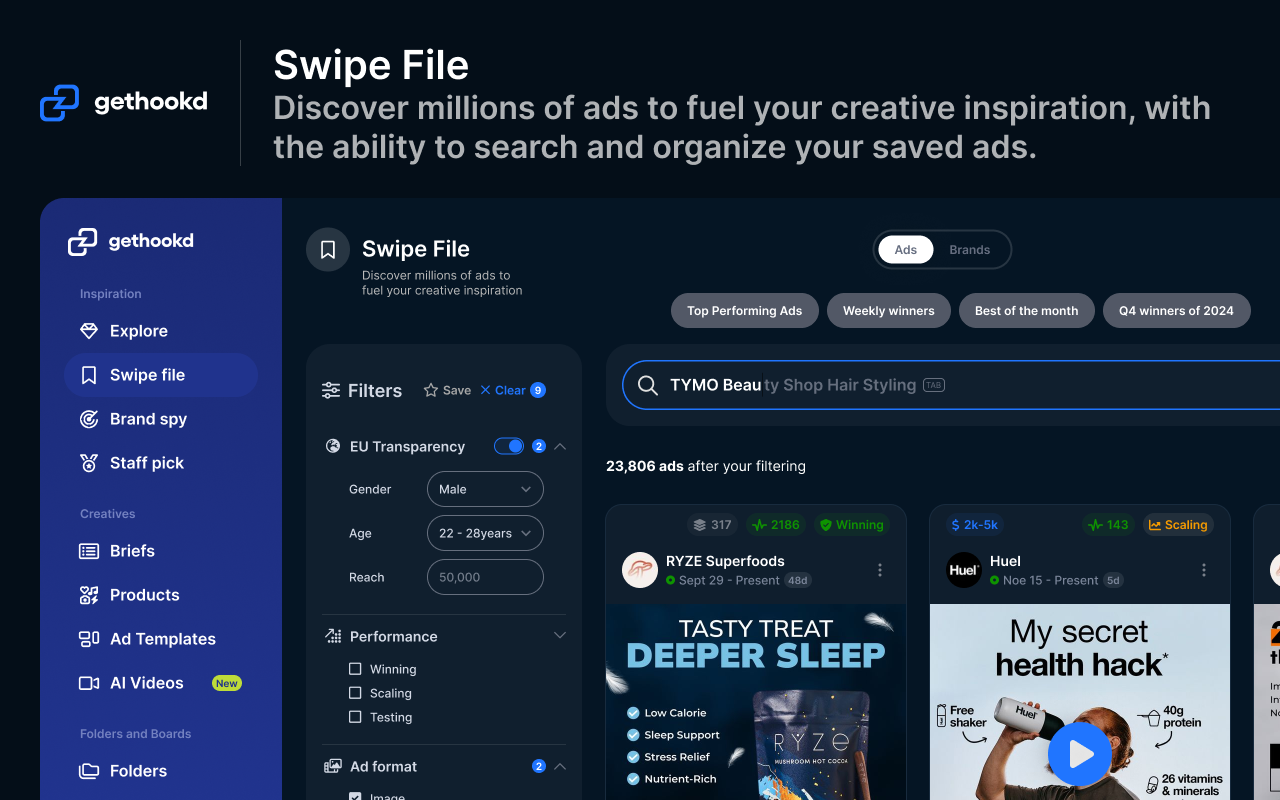
Swipekit is a Chrome-based ad library tool priced from $26/month. It lets marketers save ads from the Facebook Ad Library, TikTok Creative Center, TikTok Ad Library, and LinkedIn Ad Library with one click, organize them into shareable boards, and automatically track competitor brand activity via Brand Tracker.

The platform also includes an AI Scriptwriter that generates ad concepts, ad copy, and video-to-storyboard outputs directly from saved ads. All plans include a 14-day free trial with no credit card required. For small teams on a budget, Swipekit covers the basics well. For teams actively scaling paid campaigns, the platform's depth becomes a limiting factor, and alternatives like GetHookd offer more at a better price.

GetHookd: Turn Competitor Intelligence Into Your Next Winning Ad

65M+ Ads Analyzed | 4.8★ G2 Rating | 4.5★ Trustpilot Rating

Stop Guessing. Start Scaling:

GetHookd reveals which ads your competitors are actively scaling—not just running. Spy on their best-performing creatives, landing pages, and traffic strategies, then turn proven concepts into testable campaigns in seconds with AI-powered script generation and creative cloning.

What You Get:
  • ✓ Brand Spy to decode competitor ad strategies in real-time
  • ✓ AI script generation and ad cloning for instant variations
  • ✓ Performance scoring based on actual ad behavior, not vanity metrics
  • ✓ Creative Analyzer to identify and scale your top performers
Replace guesswork with intelligence. Build profitable ads that actually convert.

What Is Swipekit?

Swipekit is a Chrome extension and web dashboard that lets users capture ads from the Facebook Ad Library, TikTok Creative Center, TikTok Ad Library, and LinkedIn Ad Library with a single click. Saved ads live in a centralized dashboard where teams can tag, filter, organize into boards, and share with collaborators via public links or direct embeds into tools like Notion and Clickup.

The Brand Tracker automatically scrapes new competitor ads on a recurring schedule and generates insights, including creative format breakdowns, posting timelines, landing page links, and common ad copy patterns, eliminating the need to manually check ad libraries.

Swipekit operates as a Chrome extension and web dashboard that centralizes ad saving, competitor brand tracking, and creative organization across five major ad libraries. (Image source: Swipekit)

Key Features of Swipekit

Here are the key features of Swipekit:

  1. Brand Tracker runs continuously in the background, scraping competitor brands on the Facebook Ad Library automatically. It generates periodic insights covering ad copy patterns, asset type breakdowns (static vs. video vs. other formats), posting timelines, and the landing pages competitors are driving traffic to.
  2. AI Scriptwriter converts any saved ad into ad concepts, copy variations, or shot-by-shot video storyboards. Outputs are structured in Markdown and JSON, making them directly usable in tools like ChatGPT, Veo, or Sora for further production.
  3. Swipe File and Boards let users organize saved ads into unlimited tagged boards that can be shared with clients, embedded in Notion or ClickUp, or published as public-facing mood boards.
  4. Ad Transcription auto-generates text transcripts for video ads, which can be dropped into creative briefs or used as a starting point for copy remixing.
  5. Ad Metrics display estimated reach, ad spend estimates, and running duration for ads saved from the Facebook Ad Library.

Swipekit Pricing

All three Swipekit plans include unlimited ad saving, access to the Swipekit shared multiplayer library of over 500,000 ads, landing page screenshots, ad reach and spend estimates, and priority support. The main difference between tiers is tracked brand limits and team seats.

  • Basic Plan ($26/month): Track up to 5 brands, invite up to 4 team members.
  • Plus Plan ($46/month): Track up to 10 brands, invite up to 9 team members.
  • Agency Plan ($66/month): Track up to 15 brands, invite up to 14 team members.

Annual billing reduces costs on each plan, and all tiers include a 14-day free trial with no credit card required.

Swipekit Reviews: What Users Are Saying

Based on reviews from the Chrome Web Store, Swipekit holds a 4.4-star rating. Users consistently praise the clean, minimal interface and the Brand Tracker's ability to centralize competitor monitoring without manual work. Permanent ad storage and video transcription are called out as practical time-savers.

Recurring criticisms center on login and authentication failures, reports of paying users losing access without resolution, and slow or absent responses from support when technical issues arise.

A real user highlights how Swipekit's keyword-based matching stands out from competing apps, with early results already promising enough to inspire long-term optimism.

3 Swipekit Alternatives Worth Considering

1. GetHookd

GetHookd positions itself as a competitive ad intelligence and creative production platform for performance marketers running paid campaigns primarily on Meta and the Facebook Ad Library.

GetHookd is a competitive ad intelligence and creative production platform built for performance marketers, media buyers, and eCommerce brands running paid campaigns on Meta. Explore Ads lets you quickly find proven ad ideas by browsing a library of 65 million plus Meta ads, helping you spot what’s gaining traction in your niche and turn those insights into new campaigns.

Our Brand Spy feature identifies the ads competitors are actively scaling, including their landing pages and traffic sources. Video Scripts uses an AI copywriter trained on 8-figure direct response campaigns to generate hooks, angles, and full scripts in seconds. Clone Ads generates image variations from any uploaded creative and is available on the Grow and Scale plans. Creative Analyzer scores existing ads to identify top performers.

Our pricing plan starts at $19/month with a 7-day free trial, giving teams access to the full research and production workflow. We hold 4.8 stars on G2 and 4.5 stars on Trustpilot.

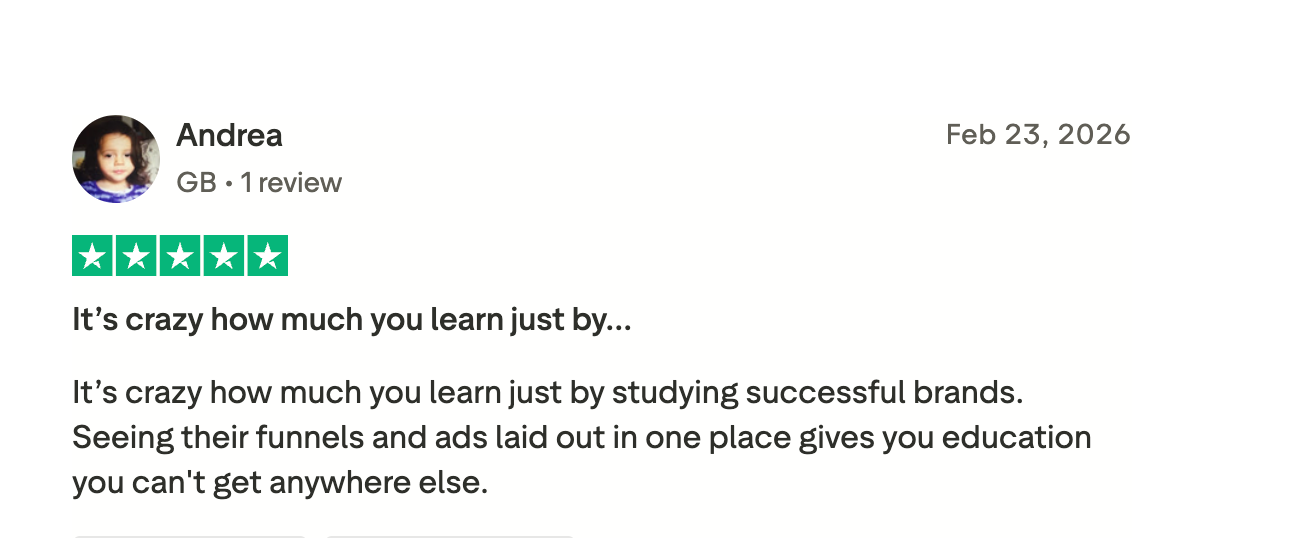
A verified user notes that seeing competitor funnels and ads in one place delivers a level of practical marketing education that's hard to find elsewhere.

2. Foreplay

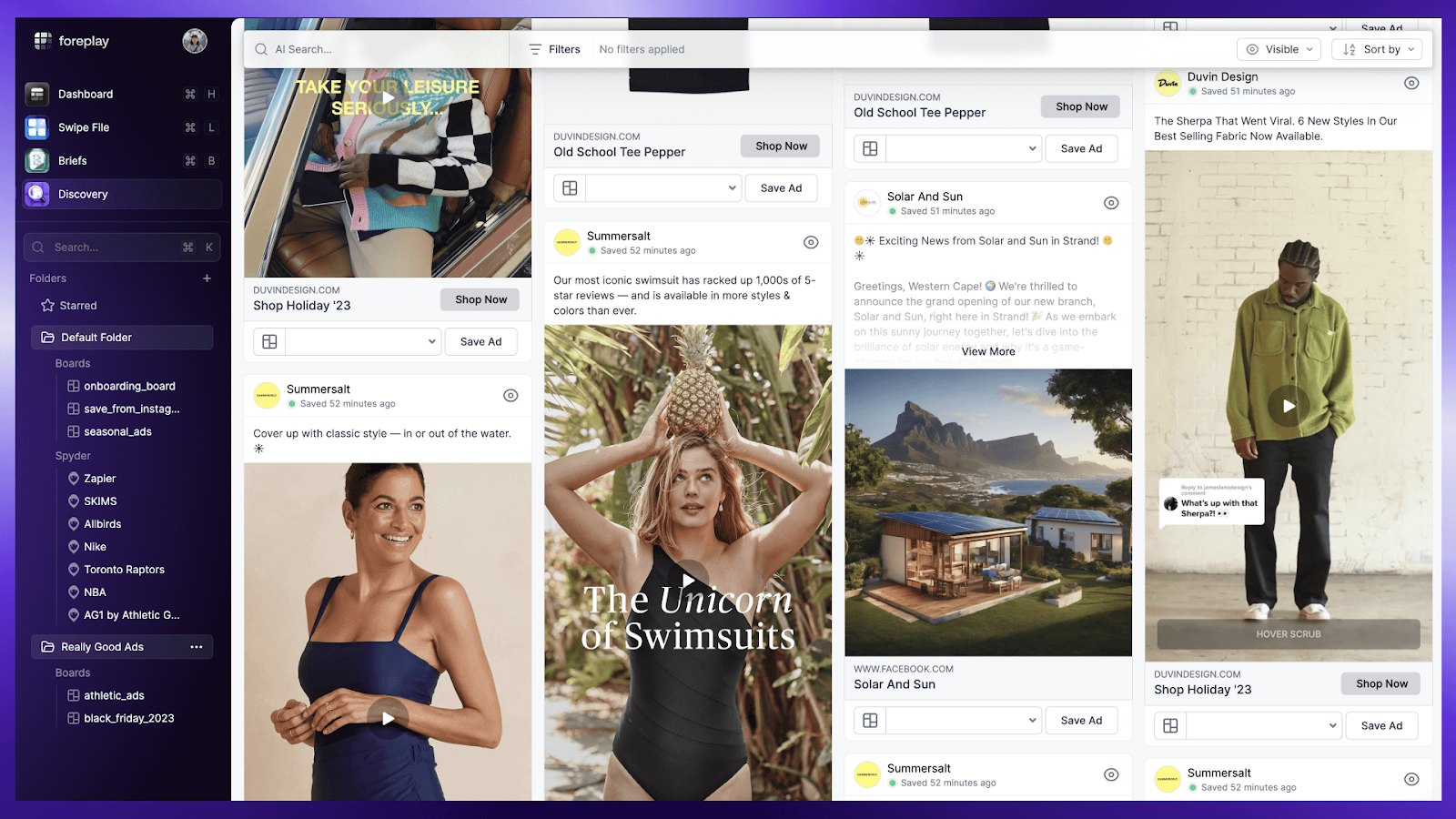
Foreplay serves creative strategists and performance teams seeking an end-to-end workflow covering ad research, competitor tracking, creative analytics, and brief production within one platform. (Image source: Foreplay)

Foreplay is an established creative workflow platform with a community-curated library of over 70 million saved ads. Its Spyder tool automates competitor tracking across Meta, building detailed reports on ad activity, top hooks, and landing page insights. The Lens feature connects directly to ad account data for creative analytics. Foreplay also includes AI brief and storyboard tools, plus a mobile app for saving ads on the go.

Based on G2 reviews, Foreplay holds a 4.8-star rating. Users consistently highlight the breadth of features and strong collaboration tools. However, smaller teams frequently cite the pricing as a significant jump compared to lighter tools. Foreplay's Basic plan starts at $59/month (or $49/month billed annually), with a Workflow plan at $175/month and an Agency plan at $459/month.

3. MagicBrief

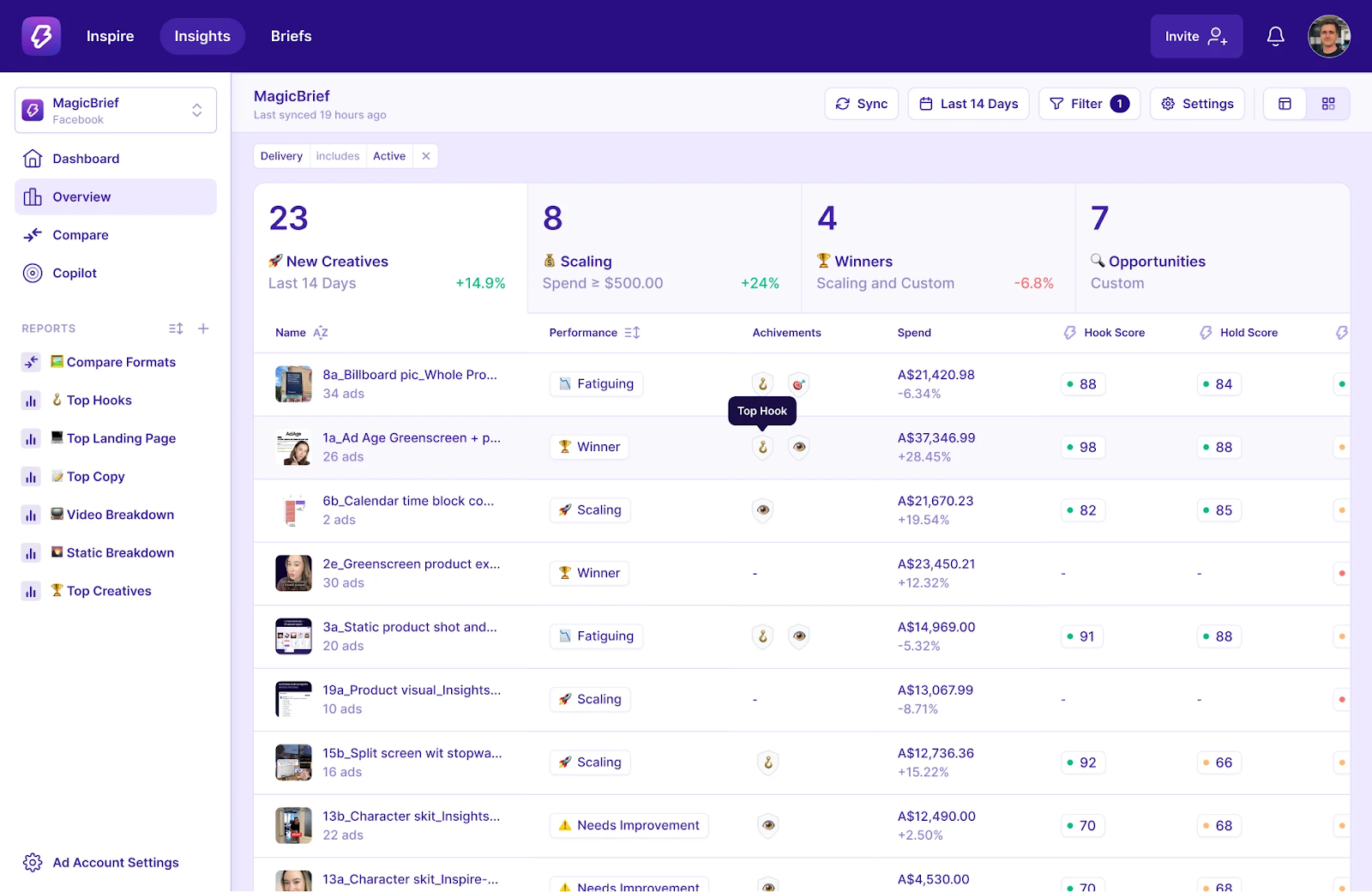
MagicBrief targets mid-to-enterprise creative and media teams requiring integrated creative analytics alongside competitor research, connecting ad account performance data directly to creative production workflows. (Image source: MagicBrief)

MagicBrief is built for creative and media teams that want to connect competitor research directly to live campaign performance. 

Its AI-powered library covers over 12 million ads, searchable by brand, industry, ad type, and theme. The platform syncs with Meta, TikTok, YouTube, and LinkedIn ad accounts to generate creative performance reports that identify which specific elements drive results. It is used by 3,432 creative teams worldwide.

MagicBrief pricing starts at $249/month on an ad spend-based model. A 7-day free trial is available.

Top Swipekit Alternatives: Summary Table

Features GetHookd Swipekit Foreplay MagicBrief
Starting Price $19/month $26/month $59/month $249/month
Free Trial 7 days 14 days 7 days 7 days
Ad Database 65M+ analyzed 500K+ shared 70M+ saved 12M+ curated
Platform Focus Meta / Facebook Ad Library Facebook, TikTok, LinkedIn Meta, TikTok, YouTube Meta, TikTok, YouTube, LinkedIn
AI Script Generation Yes Yes Yes Yes
Ad Cloning / Variations Yes No No No
Performance Scoring Yes Limited (run duration only) Yes (Lens) Yes
Competitor Ad Tracking Yes Yes Yes (Spyder) Yes

Why GetHookd Is the Stronger Alternative to Swipekit

Swipekit works well as a lightweight swipe file tool for teams that need basic ad saving and competitor monitoring on a budget. For marketers actively running campaigns who need to identify what competitors are scaling, produce creatives quickly, and score what is worth spending more on, the platform's depth becomes a constraint.

At GetHookd, we built our platform to address that gap. Our Brand Spy surfaces real scaling signals, going beyond publicly visible ads. Our AI and production tools let teams act on competitor intelligence without leaving the platform. And with pricing starting at $19/month, we offer more capability at a lower entry cost than any tool in this comparison.

Start your GetHookd free trial today!

Frequently Asked Questions (FAQs)

What is Swipekit used for?

Swipekit is a Chrome-based ad library tool for saving and organizing creatives from the Facebook Ad Library, TikTok Creative Center, TikTok Ad Library, and LinkedIn Ad Library. It includes a Brand Tracker for automated competitor monitoring on Facebook and an AI Scriptwriter for generating ad concepts, copy, and video storyboards from saved ads.

Is Swipekit worth it for small teams?

For small teams focused on ad organization and basic competitor tracking, Swipekit's Basic plan at $26/month covers the core use case of saving and tagging creatives, organizing into boards, and tracking up to 5 competitor brands. The platform also includes AI script generation across all plans, which lets teams turn saved ads into ad concepts, copy, and storyboards without leaving the tool. All plans include a 14-day free trial with no credit card required.

Does Swipekit show ad performance data?

Swipekit shows estimated reach, ad spend estimates, and running duration for ads saved from the Facebook Ad Library. The Ad Tracker pings saved Facebook ads to check whether they are still active, and ads can be sorted by running duration so that the longest-running ads, typically a proxy for performance, surface at the top of your library.

How often should I research competitor ads?

For active campaigns, weekly competitor monitoring provides enough signal to catch new creatives and test new angles before they oversaturate. Monthly reviews help identify bigger strategic shifts, such as a competitor repositioning an offer or launching a different ad format. During high-spend periods or major promotions, checking more often gives you a faster read on what your competitors are scaling.

Why do performance marketers choose GetHookd over Swipekit?

GetHookd goes well beyond saving ads. Our Brand Spy identifies which ads are being actively scaled, rather than which ones are merely visible. Our Video Scripts and Clone Ads tools let teams turn competitor intelligence into testable creatives in minutes. Our performance scoring helps teams decide which ads deserve more budget. For marketers running real campaigns, having research and creative production in one platform reduces guesswork and gets winning ads live faster.

*Note: Pricing and/or product availability mentioned in this post are subject to change. Please check our website for current pricing and stock information before making a purchase.
GetHookd Ads Library vs Facebook Ads Library
Gethookd vs Meta Ads Library
-
March 30, 2026

Foreplay Reviews, Pricing & Alternatives: Is This AI Ads Tool Worth It?

Key Takeaways

  • Foreplay is a widely used ad research and workflow platform. It helps teams find, save, and organize ads, track competitors, and build creative briefs in one workflow.
  • Best features are locked behind higher tiers. Key tools like competitor tracking (Spyder) and analytics (Lens) only start at $175/month, limiting the Basic plan.
  • Users praise it for speed and simplicity, but many consider it expensive, especially for smaller teams.
  • Foreplay’s alternatives like GetHookd, MagicBrief, and Atria provide similar features, sometimes with cheaper entry points or built-in competitor tracking.
  • GetHookd gives performance marketers a 65M+ analyzed Meta ad database, AI script generation, ad cloning, and Brand Spy, starting at $19/month.

Foreplay: Is This AI Ads Tool Worth It?

Foreplay is worth it for creative teams managing high-volume ad workflows, but the entry plan is too limited for teams that need competitive intelligence from day one. 

It is a creative research and ad workflow platform built for performance marketers, agencies, and e-commerce teams. It covers ad discovery, swipe file organization, competitor monitoring, creative analytics, and AI-assisted brief building, making it a reasonably complete tool for creative teams managing ad production at scale.

This review covers Foreplay's full feature set, verified user feedback, pricing across all tiers, and three alternatives, including GetHookd, MagicBrief, and Atria, to help you choose the right fit.

GetHookd: Turn Competitor Intelligence Into Your Next Winning Ad

65M+ Ads Analyzed | 4.8★ G2 Rating | 4.5★ Trustpilot Rating

Stop Guessing. Start Scaling:

GetHookd reveals which ads your competitors are actively scaling—not just running. Spy on their best-performing creatives, landing pages, and traffic strategies, then turn proven concepts into testable campaigns in seconds with AI-powered script generation and creative cloning.

What You Get:
  • ✓ Brand Spy to decode competitor ad strategies in real-time
  • ✓ AI script generation and ad cloning for instant variations
  • ✓ Performance scoring based on actual ad behavior, not vanity metrics
  • ✓ Creative Analyzer to identify and scale your top performers
Replace guesswork with intelligence. Build profitable ads that actually convert.

Foreplay's Core Features

Foreplay organizes its product across four main tools that span the research and production workflow.

Swipe File

Swipe File is the original core of the platform. Using the Foreplay Chrome extension, users can saves ads from the Meta Ad Library, TikTok Creative Center, TikTok Top Ads, LinkedIn, YouTube Shorts, and more into organized boards with custom tags, ratings, and comments. 

Note that Instagram ads are part of the Meta ecosystem and are saved via the Facebook Ad Library. Saved ads remain in your library permanently, even after the original campaigns end.

Foreplay's Swipe File dashboard displays saved ads organized into boards with custom tags, showing how creative teams manage ad inspiration across active campaigns. (Image source: Foreplay)

Discovery

Discovery is the platform's searchable ad database, holding over 100 million ads. The community-curated portion exceeds 70 million ads saved by other marketers. AI-powered search and advanced filters help surface relevant creatives by brand, niche, format, or platform without manually scrolling through ad libraries.

Spyder

Spyder handles automated competitor monitoring and is only available on the Workflow plan and above. It continuously tracks competitor brands, captures every new ad they launch, and stores ad history back up to 3 years. The data includes media mix breakdowns, landing page insights, and top-performing hooks extracted from monitored brands.

Lens

Lens is the platform's creative analytics dashboard, also gated behind Workflow and above, showing which of your own connected ad account creatives are performing. Unlike most analytics tools, Lens does not charge based on your ad spend. Briefs rounds out the suite with AI script generation, storyboard building, and modular brief creation, and is accessible across all paid plans.

Foreplay Pricing

All Foreplay plans include a 7-day free trial. Note that while Foreplay’s website states no credit card is required, the FAQ on the same site states a credit card must be entered at sign-up. Annual billing reduces prices by approximately 15%.

  • The Basic plan costs $59/month ($49/month annually) and includes 1 user with access to Swipe File, Discovery, and Briefs. Spyder and Lens are not available at this tier.
  • The Workflow plan is $175/month ($149/month annually) and covers up to 5 users, Spyder for up to 15 brands (unlimited with annual billing), and Lens analytics for 1 connected brand with unlimited ad spend.
  • The Agency plan runs $459/month ($389/month annually) and supports up to 10 users, Spyder for 50 brands (unlimited on annual), and Lens for up to 10 brands. 

Additional users cost $20 per seat across all plans. Enterprise pricing is custom and includes unlimited users and priority in-app or Slack support.

Foreplay Verified User Reviews

Foreplay has a 4.8 out of 5 rating on G2, based on about 120 verified reviews, with 91% of reviewers awarding 5 stars. On the Chrome Web Store, the extension carries a 4.9 out of 5 from 237 ratings. The most consistent praise centers on time savings and ease of use, with reviewers highlighting fast ad research, smart filtering, and an uncluttered interface. Agency users in particular describe it as a core daily tool that keeps entire teams aligned around a shared creative library.

The most recurring criticism is cost. "Expensive" is the single most cited negative tag across all verified G2 reviews, appearing multiple times. A smaller number of reviewers note that the platform is primarily built for social ads, making it less useful for teams focused on Google Search campaigns.

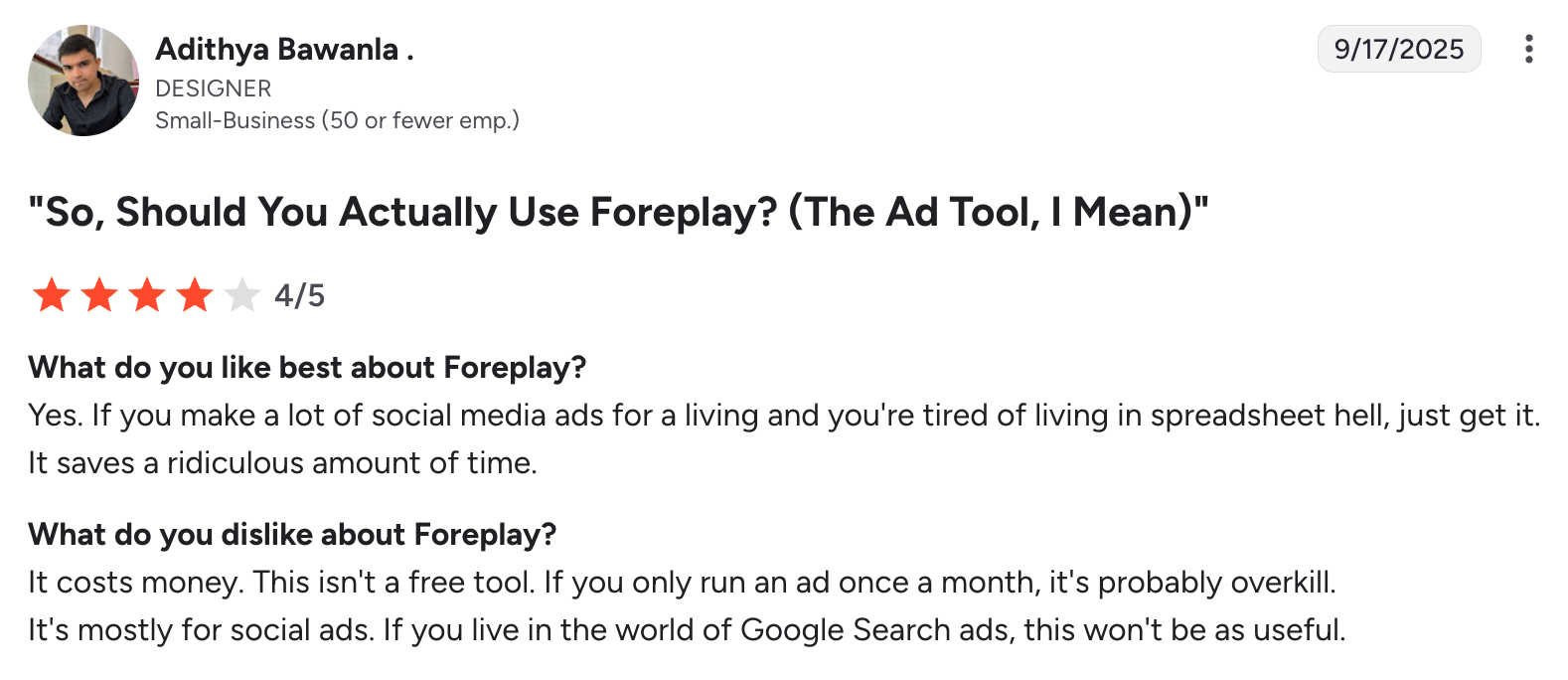
Verified user reviews on G2 reflect consistently positive sentiment around Foreplay's time-saving research features, alongside recurring concerns about per-seat pricing for larger teams.

Top Alternatives to Foreplay

1. GetHookd

GetHookd positions itself as a competitive ad intelligence and creative production platform for performance marketers, media buyers, and scaling e-commerce teams.

GetHookd is a competitive ad intelligence and creative production platform built for eCommerce brands, marketers, and agencies. Our platform combines ad research with AI production tools inside a single workflow.

Explore Ads helps you quickly discover effective ad ideas by searching a database of over 65 million Meta ads, so you can see what’s performing in your niche and apply those insights to your next campaign. Brand Spy is available on every plan, including the entry-level Launch tier, showing competitors' top ads, landing pages, and traffic sources based on real scaling behavior rather than vanity metrics.

Videos Script produces hooks, angles, and scripts from winning ads or product briefs using a direct-response framework built on high-converting campaigns. Clone Ads generates multiple visual variations from any image almost instantly. 

Pricing starts at $19/month for Launch (1 seat, 40 credits), $59/month for Grow (3 seats, 200 credits), and $149/month for Scale (10 seats, 800 credits). Annual billing saves 25%, and all plans include a 7-day free trial.

User feedback consistently highlights faster competitive research and reduced creative guesswork. Performance advertisers managing larger monthly budgets describe Brand Spy as a meaningful time-saver for tracking competitor activity, and reviewers across plan tiers cite AI script tools as a clear advantage for speeding up creative testing cycles.

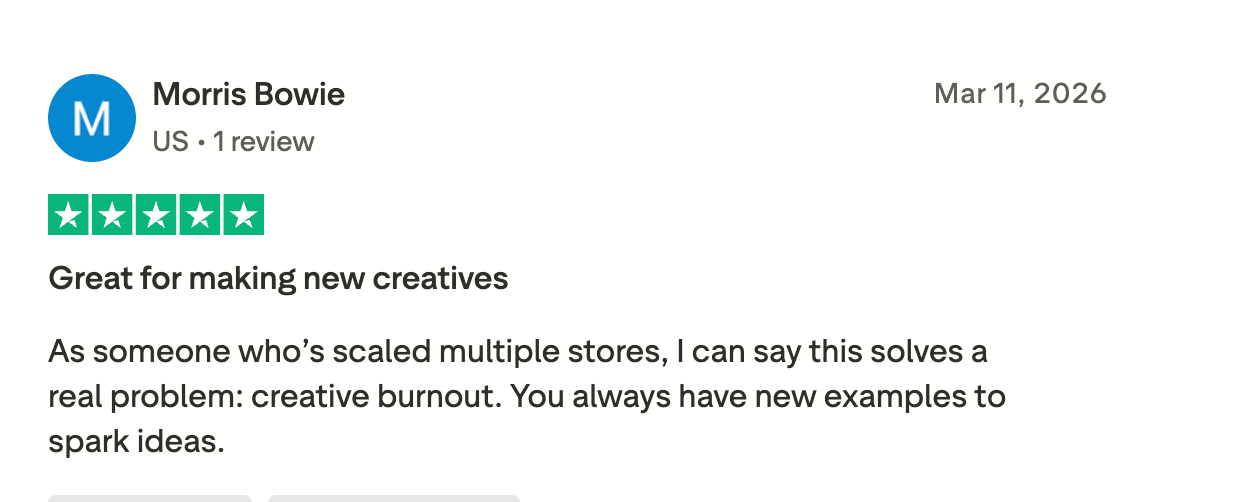
A verified user praises GetHookd for solving creative burnout by keeping fresh ad inspiration consistently within reach.

2. MagicBrief

MagicBrief serves agencies and established marketing teams with a brief-building workflow, collaborative storyboarding tools, and a 12 million+ ad research library. (Image source: MagicBrief)

MagicBrief is a creative workflow and brief-building platform aimed at agencies and established marketing teams that need structured creative direction backed by performance data. Its searchable ad library spans 12 million+ ads, with AI-powered search and a curated Discover Library of filtered ad inspiration organized by theme and format.

MagicBrief's brief builder supports real-time team collaboration, persistent share links, and structured storyboarding. Unlike Foreplay's per-seat model, MagicBrief includes unlimited workspace members at no additional cost, which is a meaningful difference for larger agency teams.

Two commercial factors matter before signing up. First, MagicBrief requires an initial 3-month subscription commitment before billing transitions to monthly. Second, pricing starts at $249/month and scales with ad spend, making it a significantly higher entry point than most tools in this comparison.

3. Atria

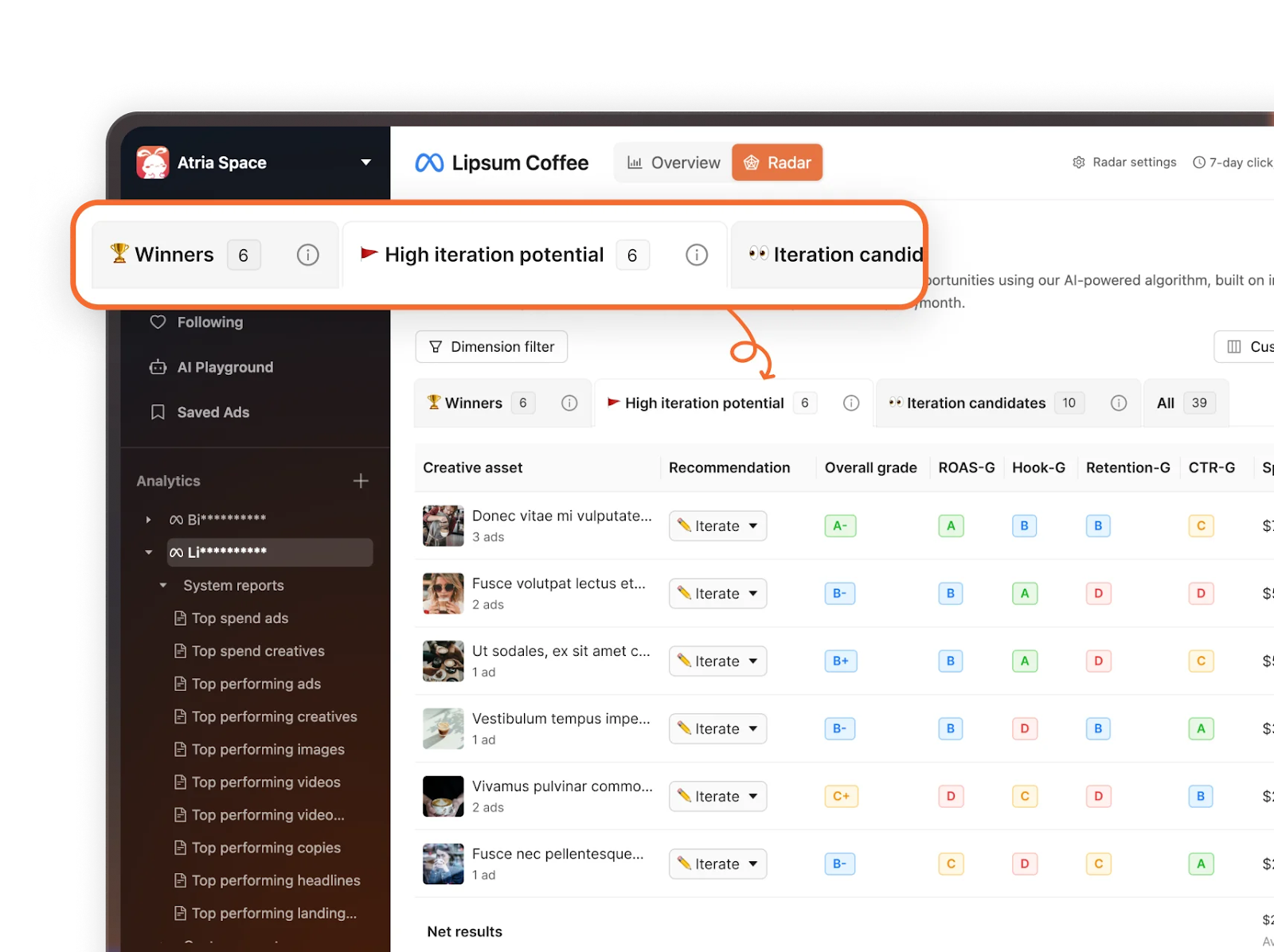
Atria targets performance marketing teams with AI-powered creative scoring and competitor ad tracking, positioned at a higher price point than most tools in this comparison. (Image source: Atria)

Atria is an AI-powered creative management platform covering competitor research, ideation, ad creation, and performance analysis. 

The Radar feature acts as a 24/7 AI strategist available on all plans, and the platform includes AI-generated images, ad cloning, scripts, hooks, and concept generation. Competitor brand tracking is available on all tiers, with Core allowing up to 50 brands and Plus up to 100 brands.

The Core plan is $129/month (billed annually), and the Plus plan is $269/month (billed annually), with annual billing saving 20%. Business and Enterprise tiers are custom-priced.

Top Foreplay Alternatives: Summary Table

Features GetHookd Foreplay MagicBrief Atria
Starting Price $19/month $59/month $249/month $129/month (annual)
Free Trial 7 days 7 days 7 days 7 days
Ad Database 65M+ ads 100M+ ads 12M+ ads 25M+ ads
Competitor Tracking All plans Workflow plan+ All plans All plans
AI Script Generation All plans All paid plans No All plans
Ad Cloning / Image Gen Grow & Scale only No No All plans
Creative Analytics Grow & Scale Workflow plan+ All plans All plans
Team Seats $20/extra seat $20/extra seat Unlimited (included) $20/extra seat
Best For eCommerce & performance marketers Agencies & creative teams Agencies needing briefs Data-driven performance teams
Notable Limitation Clone Ads not on Launch plan Spyder/Lens gated at entry tier 3-month minimum commitment Higher entry price

Why GetHookd Is Better Than Foreplay for Performance Advertisers

Foreplay stops at research and briefing, which works for creative teams organizing inspiration. For media buyers, dropshippers, and agencies that need to move from competitive insight to a live, testable ad without switching tools, that gap in the workflow adds up in both time and wasted spend.

At GetHookd, we built the entire creative production workflow into a single platform. Brand Spy, AI Script Generation, Clone Ads, and the Creative Analyzer work together so your team can go from spotting a winning competitor ad to launching your own variation without leaving the platform or waiting on a separate creative team.

See why teams choose GetHookd over Foreplay.

Frequently Asked Questions (FAQs)

Does Foreplay offer a free plan?

Foreplay does not have a permanent free plan. All three paid tiers include a 7-day free trial. Note that a credit card is required at sign-up; after the 7-day period, the card is charged automatically unless the trial is cancelled first. After the trial period ends, a paid subscription is required to continue accessing the platform.

Is competitor tracking included on Foreplay's Basic plan?

No. Spyder, the automated competitor monitoring feature, is only available on the Workflow plan ($175/month) and above. Basic plan subscribers can save and organize ads, but cannot access competitor tracking or Lens creative analytics at that tier.

Does using GetHookd require technical skills?

No. GetHookd is built for marketers, not developers. The interface is straightforward, and most users complete onboarding in under 30 minutes. All core features, including Explore Ads, Brand Spy, Video Scripts, and Clone Ads, run directly in the browser with no technical setup required.

How does GetHookd go further than a standard ad library?

GetHookd is a decision-support platform built for people actively running and testing ads. Our Brand Spy surfaces which creatives competitors are scaling based on real performance signals, rather than simply showing what is live. Combined with Video Scripts, Clone Ads, and the Creative Analyzer, we help teams move from competitive research to testable campaigns without leaving the platform.

*Note: Pricing and/or product availability mentioned in this post are subject to change. Please check our website for current pricing and stock information before making a purchase.
GetHookd Ads Library vs Facebook Ads Library
Gethookd vs Meta Ads Library
-
March 29, 2026

5 Best Dropshipping Facebook Ad Examples

Key Takeaways

  • Five Facebook ad formats dominate dropshipping results right now. UGC videos, carousel ads, product demos, dynamic retargeting ads, and Stories/Reels each target different stages of the buyer journey.
  • Video-first creatives consistently outperform static images. Short, engaging videos blend into feeds, grab attention quickly, and build trust through visual proof and real-world use.
  • Retargeting ads drive the highest conversions. Dynamic product ads show shoppers items they already viewed, making them highly effective for closing sales.
  • Winning ads focus on speed, clarity, and mobile-first design. Hook viewers in seconds, keep content short (5–15 seconds), and use vertical formats with clear CTAs to maximize results.
  • GetHookd gives dropshippers access to 65M+ analyzed ads across Meta, so you can find proven creative concepts and turn them into testable campaigns in minutes.

The 5 Facebook Ad Formats Driving Dropshipping Sales Right Now

The five best dropshipping Facebook ad examples are UGC problem-solution videos, multi-product carousels, short-form product demos, dynamic product retargeting ads, and vertical Stories/Reels ads. Each format targets a different stage of the buying journey, from grabbing cold traffic attention to closing the sale with warm shoppers who already browsed your store.

These five formats consistently outperform static image ads because they combine visual proof, social trust, and urgency in ways that match how people actually scroll through Facebook and Instagram in 2026. 

With Facebook alone reaching over 3.07 billion monthly active users and the median ecommerce ad CTR sitting around 2.19% across Meta, dropshippers who nail their creative strategy have a massive opportunity. The breakdown below covers what each winning ad type looks like in practice, why it works, and how to apply it to your own campaigns.

GetHookd: Turn Competitor Intelligence Into Your Next Winning Ad

65M+ Ads Analyzed | 4.8★ G2 Rating | 4.5★ Trustpilot Rating

Stop Guessing. Start Scaling:

GetHookd reveals which ads your competitors are actively scaling—not just running. Spy on their best-performing creatives, landing pages, and traffic strategies, then turn proven concepts into testable campaigns in seconds with AI-powered script generation and creative cloning.

What You Get:
  • ✓ Brand Spy to decode competitor ad strategies in real-time
  • ✓ AI script generation and ad cloning for instant variations
  • ✓ Performance scoring based on actual ad behavior, not vanity metrics
  • ✓ Creative Analyzer to identify and scale your top performers
Replace guesswork with intelligence. Build profitable ads that actually convert.

5 Best Dropshipping Facebook Ad Examples

1. The UGC Problem-Solution Video Ad

User-generated content (UGC) video ads feature a real person facing a common problem and using your product to solve it. These ads mimic organic posts, which means they blend into the feed and lower the resistance buyers typically feel toward unfamiliar stores. A strong UGC ad follows a simple formula: hook the viewer with a relatable pain point in the first two seconds, demonstrate the product in action, and close with a direct call to action, such as "Shop Now."

For example, a glasses retailer ran a UGC-style video where a customer explained the frustration of finding affordable varifocal lenses, then showed how the product delivered quality at a lower price. The spoken content was conversational and concise, the demo was visual, and the ad included a 120-day free returns guarantee to reduce hesitation. This pattern works across niches, from pet grooming tools to kitchen gadgets and beauty devices.

What makes it work: The ad feels like a recommendation from a friend, not a sales pitch. Keep videos under 15 seconds, film in vertical format, and add captions for sound-off viewers.

UGC video ads convert because they mimic organic posts, building trust through relatable storytelling and real product demonstrations in under 15 seconds.

2. The Multi-Product Carousel Ad

Carousel ads let you display up to 10 images or videos in a swipeable format, each with its own link and headline. They are ideal for dropshippers with diverse catalogs or stores that sell products with multiple variations (sizes, colors, styles). A custom pet sock brand, for instance, used a carousel in which each card featured a different pet alongside its personalized sock design. The accompanying text simplified the ordering process into three steps, and the ad promised delivery within 3 to 6 days.

This format works because it gives shoppers more surface area to find something they connect with. Each card acts as a mini ad, and the swipe interaction keeps users engaged longer than a static image would. Fitness dropshippers have also used carousels to display before-and-after results across multiple cards, creating a visual narrative that builds curiosity with each swipe.

What makes it work: Lead with your strongest image on the first card. Keep headlines to 40 characters or fewer and primary text under 125 characters. Three to five cards tend to perform better than using all ten.

Carousel ads give dropshippers multiple engagement points in a single ad unit, with three to five cards typically outperforming longer sequences.

3. The Short-Form Product Demo Video

Product demo videos showcase your item in action, typically within 10 to 15 seconds. Unlike UGC ads that rely on a person's testimony, demo videos focus entirely on the product itself. A pet hair remover ad, for example, showed the device cleaning a couch in seconds, followed by a side-by-side comparison with a traditional lint roller. No voiceover, no text walls. Just a clear visual demonstration of the product's benefit.

These ads perform well for gadgets, beauty tools, home organization items, and any product where the value becomes obvious through a quick visual proof. The key is speed. Show the product solving the problem within the first three seconds. If the viewer has to wait to understand what you are selling, they have already scrolled past.

What makes it work: Film the demo on a clean, uncluttered background. Use quick cuts and zoom-ins to highlight key features. Add a text overlay with the main benefit (for example, "Removes pet hair in one swipe") and end with a "Shop Now" CTA.

Product demo videos work best when the item's value is visually obvious within the first three seconds, making them ideal for gadgets and beauty tools.

4. The Dynamic Product Retargeting Ad

Dynamic product ads (DPAs) automatically pull items from your product catalog and show them to people who have already visited your store, viewed specific products, or added items to their cart. These ads work because the targeting is hyper-specific: the viewer sees the exact product they browsed, paired with urgency-driven copy like "Still available" or "Only a few left."

For dropshipping stores with catalogs of 20 or more products, DPAs remove the need to create individual ads for each item. Meta's algorithm selects the most relevant product for each viewer based on their browsing behavior. A home decor dropshipper, for instance, might show a customer the exact throw pillow they viewed yesterday, complete with the original price and a free shipping tag.

What makes it work: Install the Meta Pixel on your store and keep your product catalog up to date. Use carousel or single-image formats for DPAs. Pair the automated product selection with short, action-oriented copy. Retargeting warm audiences typically delivers conversion rates much higher than those of cold-traffic campaigns.

5. The Stories & Reels Vertical Ad

Vertical, full-screen ads on Facebook Stories and Instagram Reels have become a go-to format for dropshippers targeting mobile users. These ads fill the entire screen, eliminating distractions and forcing viewers to engage or swipe away. Successful Stories ads feature bold text overlays, quick product shots, and limited-time offers that create urgency.

A beauty dropshipper, for example, ran a 10-second Reel ad showing a serum application with a text overlay reading "Visible results in 14 days" and a "Swipe Up" CTA. The native feel of the format made it blend naturally with organic Reels content, resulting in higher watch-through rates. Flash sales, new arrivals, and seasonal promotions perform especially well in this placement.

What makes it work: Film in 9:16 vertical format. Keep the ad between 5 and 15 seconds. Front-load the hook within the first second using bold text or a surprising visual. Avoid heavy branding that makes the ad feel overly commercial.

Vertical Stories and Reels ads occupy the full mobile screen, eliminating distractions and creating urgency with bold text overlays and limited-time offers.

5 Best Dropshipping Facebook Ad Examples: Summary Table

Company Ad Strategy Key Offer Unique Approach
Redfin Cost-efficiency & value transparency Sell for a 1% listing fee Focuses on the financial benefit of the seller, using a clear "Save $X" hook to differentiate from traditional high-commission agents
The Agency Lifestyle & luxury aspirational branding Luxury property showcase and global network access Uses high-production video and storytelling to position the brand as a lifestyle choice rather than a transactional service
Zillow Data-driven empowerment & accessibility Real-time home valuations and "Zestimate" updates Hooks users through curiosity and information ownership, making the app an essential tool for market monitoring

How GetHookd Helps You Find Winning Dropshipping Ads Faster

GetHookd gives dropshippers access to over 65 million analyzed Meta ads, with Brand Spy, AI script generation, and creative cloning built into one platform.

Studying successful ads is the fastest way to build campaigns that convert, and at GetHookd, we make that process faster and more reliable. Our platform gives you access to over 65 million analyzed ads across Meta, with filters for niche, format, engagement signals, and ad run time, so you can find proven creative concepts without spending hours scrolling through the Facebook Ad Library manually.

Our Brand Spy feature shows you which ads your competitors are actively scaling, along with their landing pages and traffic strategies. Once you find a winning ad, you can use our AI-powered Ads Transcription, Video Scripts, and Clone Ads tools to create testable variations in minutes.

Start your GetHookd free trial today!

Frequently Asked Questions (FAQs)

Are Facebook ads good for dropshipping?

Yes, Facebook ads can work well for dropshipping because they allow precise targeting, fast testing, and scalable traffic when paired with strong creatives and offers.

What ad format works best for dropshipping on Facebook?

Video ads, especially UGC-style and short product demos, tend to deliver the highest engagement and conversion rates for dropshipping stores. Pairing video with carousel and dynamic retargeting ads covers the full customer journey from awareness to purchase.

Can I spy on competitor Facebook ads for free?

Yes. Meta's Ad Library is a free tool that shows all active ads running on Facebook and Instagram. You can search by brand name or keyword to see competitor creatives. However, the Ad Library does not show performance data or indicate which ads are being scaled.

How does GetHookd help dropshippers build better Facebook ads?

GetHookd goes beyond what the free Meta Ad Library shows by surfacing ads based on real performance signals. Our Brand Spy feature reveals which competitor ads are actively scaling, and our AI tools let you transcribe winning scripts, generate new ad copy, and clone top-performing image ads, all from one dashboard.

Do I need technical skills to use GetHookd?

No. GetHookd is designed for media buyers, brand owners, and agencies who want fast, actionable insights, not developers. The platform requires no coding, no API setup, and no technical background. You can search competitor ads, analyse creatives, and generate AI-powered scripts directly from the dashboard within minutes of signing up.

*Note: Pricing and/or product availability mentioned in this post are subject to change. Please check our website for current pricing and stock information before making a purchase.
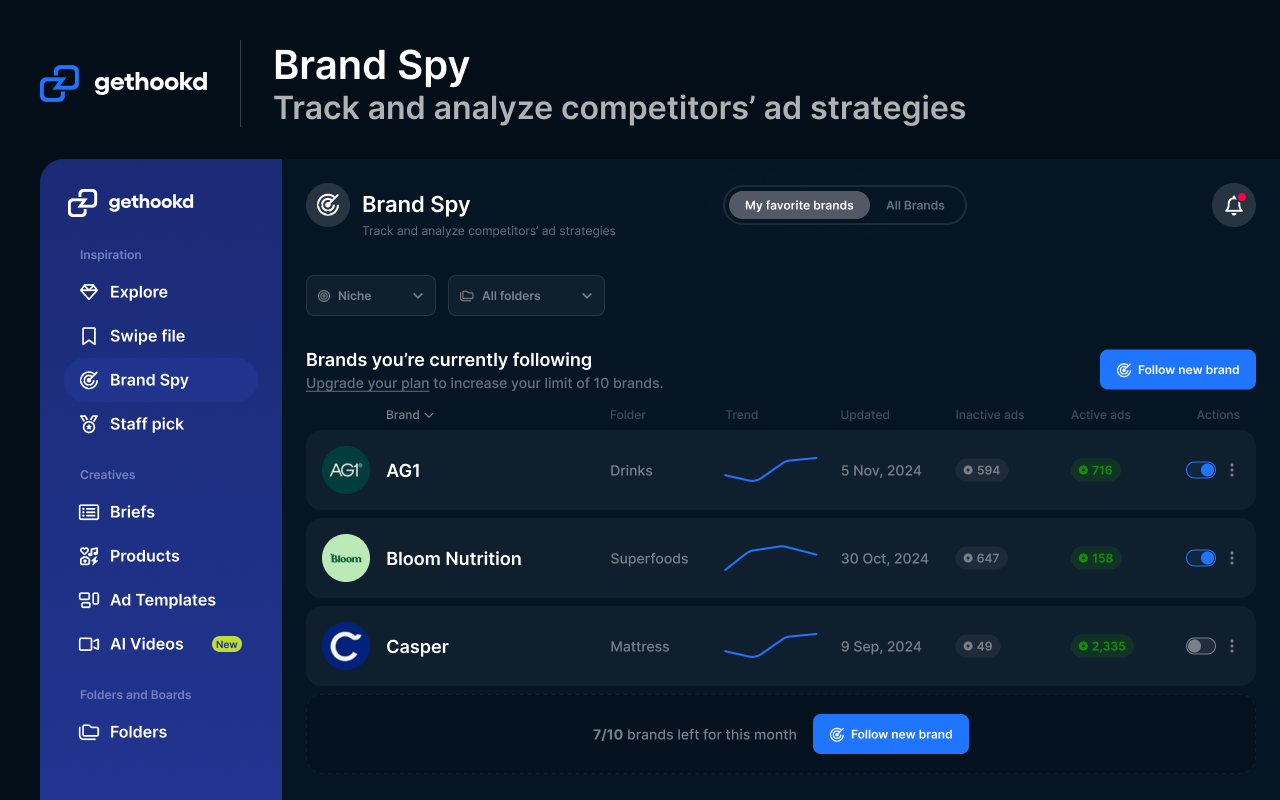
GetHookd Ads Library vs Facebook Ads Library
Gethookd vs Meta Ads Library
-
March 28, 2026

5 Best Facebook CBD Ad Examples

Key Takeaways

  • CBD ads on Facebook require a compliance-first approach. Top-performing ads avoid direct health claims and rely on lifestyle, wellness, and curiosity-driven messaging.
  • Five formats consistently drive results: lifestyle hooks, educational videos, social proof carousels, UGC-style ads, and limited-time offers each target different funnel stages.
  • The ad sells the click, not the product. Low-friction copy gets users to click, while advertorial landing pages handle education, objections, and conversions.
  • Trust and subtlety outperform aggressive selling. Native-looking content, real user experiences, and soft messaging convert better than direct, sales-heavy ads in this space. 
  • GetHookd helps media buyers and eCommerce brands find and analyze top-performing CBD ads across 65M+ Meta ads, so you can skip the guesswork and test what already converts.

Why CBD Advertising on Facebook Is a Different Game

Facebook does not allow CBD brands to make direct health claims, reference medical conditions, or use before-and-after framing in ad copy. That policy friction eliminates most conventional direct-response approaches and forces advertisers to rethink how they communicate value at the ad level.

The brands navigating this successfully follow a consistent pattern: they avoid prohibited language, lead with lifestyle and wellness angles, and rely on advertorial landing pages to handle education, objections, and conversion. The ad's job is to earn the click - nothing more.

The five formats that perform best across Meta include lifestyle hook ads, educational video ads, social proof carousels, UGC-style ads, and limited-time offer ads. Each is built around staying compliant at the ad level while maximizing purchase intent by the time a viewer reaches the landing page.

GetHookd: Turn Competitor Intelligence Into Your Next Winning Ad

65M+ Ads Analyzed | 4.8★ G2 Rating | 4.5★ Trustpilot Rating

Stop Guessing. Start Scaling:

GetHookd reveals which ads your competitors are actively scaling—not just running. Spy on their best-performing creatives, landing pages, and traffic strategies, then turn proven concepts into testable campaigns in seconds with AI-powered script generation and creative cloning.

What You Get:
  • ✓ Brand Spy to decode competitor ad strategies in real-time
  • ✓ AI script generation and ad cloning for instant variations
  • ✓ Performance scoring based on actual ad behavior, not vanity metrics
  • ✓ Creative Analyzer to identify and scale your top performers
Replace guesswork with intelligence. Build profitable ads that actually convert.

5 Best Facebook CBD Ad Examples

1. The Lifestyle Hook Ad

One of the most effective CBD ad formats on Facebook avoids mentioning CBD at all in the first three seconds. Instead, it opens with a relatable pain point: poor sleep, daily stress, or post-workout soreness. The product enters the frame naturally as part of a routine.

This approach works because it sidesteps policy friction while still addressing the buyer's problem directly. The copy typically reads something like "I started adding this to my morning routine," followed by a soft CTA like "See what others are saying." The lifestyle framing keeps the ad in review-safe territory while building curiosity.

Brands running this format consistently see strong click-through rates with warm audiences and lower CPMs than with overtly product-focused creatives.

Compliant CBD ads on Facebook lead with lifestyle and wellness angles rather than product claims, keeping ad copy policy-safe while driving curiosity to the landing page.

2. The Educational Video Ad

Short educational videos in the 30-60 second range perform well for CBD brands because they build trust before asking for a sale. A typical structure: open with a question the audience is already asking ("Why do so many people add CBD to their nighttime routine?"), walk through a plain-language explanation, then close with the product.

The key is keeping the language general enough to pass review while still being informative. Phrases like "people report" or "many users find" replace direct claims. This format works especially well for cold audiences who need context before converting.

Video content also gets more organic reach in feeds, which means even paid placements can pick up additional free impressions. For CBD brands working with conservative ad budgets, that compound effect matters.

3. The Social Proof Carousel

Carousel ads built around customer testimonials are a strong performer for CBD brands, particularly in retargeting campaigns. Each card in the carousel features a short user quote, a product image, and a single benefit callout. The final card drives to a landing page or product page.

Facebook's policy restricts fabricated health claims, but real user sentiment framed as personal experience tends to pass review. The carousel format also lets brands surface multiple angles in a single ad unit, which is useful for a product category where different buyers care about different benefits.

Brands that structure their carousels around a story arc (problem, product, outcome, action) typically see higher swipe-through and click rates than those that use the format as a static image dump.

4. The Influencer-Style UGC Ad

User-generated content (UGC) ads styled to look like organic posts consistently outperform polished brand creative for CBD. The format mimics how a real person would share a product recommendation, which reduces the visual cues that signal "this is an ad."

High-performing versions usually start with an attention-holding first line, cut to the product being used in a real-life setting, and end with a conversational CTA. The lack of heavy production value is intentional. These ads feel native to the feed, which keeps scroll-stopping rates high.

For CBD specifically, the authenticity angle also helps with trust. Buyers in this category are often skeptical of brand claims, so a recommendation framed as peer advice carries more weight than a polished spokesperson.

The soft offer and advertorial funnel keeps the Facebook ad fully compliant while using long-form editorial content on the landing page to educate, address objections, and close the sale.

5. The Limited-Time Offer Ad

Urgency-based ads work for CBD, but the execution has to be tight. The best examples pair a clean product image with a short copy block that leads with the offer, not the product. "Free shipping ends tonight" or "Starter kits are back in stock" pull attention without making any claim that could trigger a policy flag.

This format tends to perform best in retargeting, where the audience already has brand familiarity. Cold traffic rarely converts on urgency alone, but a warm audience that has already visited the product page can be pushed over the line with a well-timed offer ad.

Countdown timers in the ad creative, combined with landing pages that reflect the same offer, help maintain conversion continuity from click to checkout.

Top 5 Facebook CBD Ad Examples

Ad Format Best For Audience Type Key Strength
Lifestyle Hook Brand awareness, cold traffic Cold High relevance, low policy risk
Educational Video Trust-building, consideration Cold/Warm Builds credibility before CTA
Social Proof Carousel Retargeting, conversion Warm Multiple angles, strong CTR
UGC / Influencer-Style Feed-native engagement Cold/Warm Authentic feel, high scroll-stop rate
Limited-Time Offer Conversion, retargeting Warm/Hot Urgency drives last-click conversions

Why GetHookd Is the Smarter Way to Find Winning CBD Ads

GetHookd's Brand Spy and AI creative tools give CBD advertisers real-time visibility into what competitors are actively scaling on Meta, cutting research time and reducing wasted ad spend.

Figuring out what works in CBD advertising on your own often means wasting budget on tests that compliant brands have already run. GetHookd gives media buyers and ecommerce brands a faster way to see what is actually scaling. With Brand Spy, you can track which ads competitors are actively running on Meta, not just view static archives. Backed by 65 million plus ads, it highlights the creatives, angles, and landing pages driving real results, helping reduce policy risk before you spend.

From there, AI-powered Video Scripts and Clone Ads turn those insights into execution. Once you identify a winning format, the system generates hooks, angles, and full scripts based on proven patterns, so you can move from research to testable creative much faster.

Start your GetHookd free trial today!

Frequently Asked Questions (FAQs)

Can I advertise CBD on Facebook?

Yes, with restrictions. Facebook allows CBD ads in certain regions under specific conditions, but direct health claims and medical language are prohibited. Approved ads typically focus on lifestyle framing, personal experience language, and general wellness angles. Ad account eligibility depends on the advertiser's category approval status with Meta.

What copy angles work best for CBD ads on Facebook?

Lifestyle and routine-based angles consistently perform well because they stay compliant while addressing real buyer motivations. Pain point framing ("trouble sleeping?", "recovery days hitting harder?") combined with soft social proof tends to outperform direct product-feature copy, especially on cold audiences.

How often should you refresh CBD creatives on Facebook?

Creative fatigue typically sets in after two to four weeks for active campaigns. CBD brands running aggressive paid social budgets often rotate new creative every two weeks. Monitoring frequency scores and CTR decline in Ads Manager helps identify when a refresh is needed before performance drops significantly.

What ad formats perform best for CBD on Facebook?

Short-form video (15-60 seconds) and carousel formats consistently outperform single static images for CBD brands. UGC-style videos tend to see the strongest feed engagement because they look organic. Carousel works well for retargeting, where multiple product angles or testimonials can be shown in sequence.

How does GetHookd help with CBD ad research?

At GetHookd, our platform lets you search and filter across 65M+ analyzed Meta ads to find top-performing CBD creatives in seconds. Our Brand Spy feature shows which competitor ads are actively scaling, and our Video Scripts tool breaks down hooks, formats, and angles so you can build stronger briefs and launch better tests faster.

*Note: Pricing and/or product availability mentioned in this post are subject to change. Please check our website for current pricing and stock information before making a purchase.
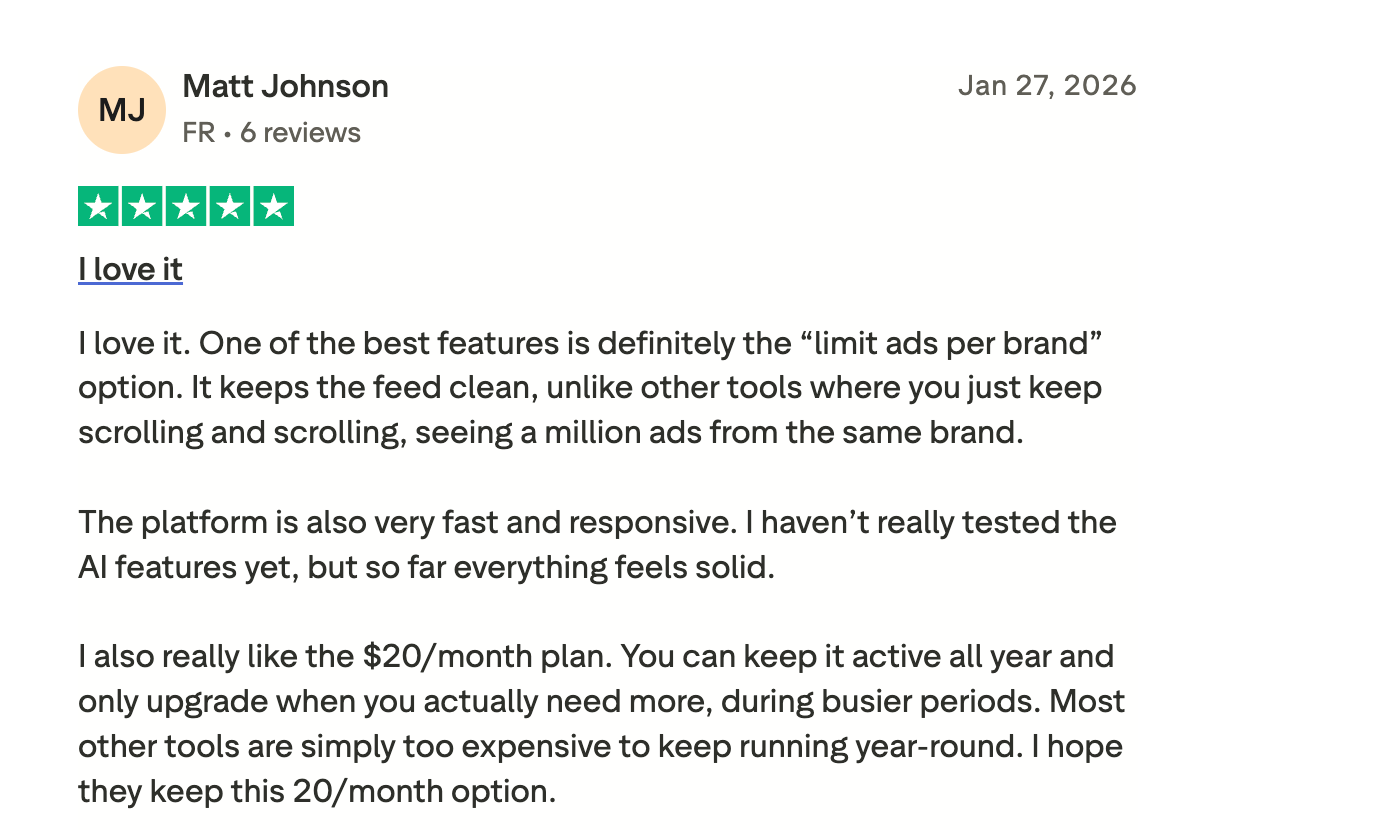
GetHookd Ads Library vs Facebook Ads Library
Gethookd vs Meta Ads Library
-
March 27, 2026

How to Find Competitors' Facebook Ads: Tools & Tips

Key Takeaways

  • The fastest way to find competitor ads is the Meta Ad Library. It’s free, requires no login, and shows all active ads across Facebook and Instagram in real time.
  • The Ad Library is useful but limited; it doesn’t show performance data, scaling insights, or historical ads once they stop running.
  • Third-party tools like GetHookd, AdSpy, and BigSpy fill the gaps by providing performance signals, ad tracking, and deeper competitive insights.
  • Real value comes from how you use the data. Focus on hooks, ad angles, and landing pages, then adapt and test, rather than copying competitors directly.
  • GetHookd combines competitor ad research across 65M+ winning ads with AI-powered creative tools, so you can go from finding winning ads to building your own in minutes.

How to Find Competitors' Facebook Ads

The fastest way to find competitors' Facebook ads is through the Meta Ad Library. It is a free, public database at facebook.com/ads/library that shows every active ad running across Facebook, Instagram, Messenger, and the Audience Network. You search by brand name or keyword, apply filters for country, platform, and media type, and instantly see what any competitor is running right now. No account or login is needed.

The Ad Library is a strong starting point, but it has limits. It does not show performance data, scaling signals, or landing page insights, and ads disappear once they stop running. That is where third-party ad research tools come in. 

Platforms like GetHookd, AdSpy, and BigSpy go further by tracking which ads competitors are actively scaling, scoring performance based on real ad behavior, and letting you turn winning concepts into new creatives with AI. 

Below, we break down exactly how to use both the free Ad Library and paid tools to build a research workflow that gives you a real competitive edge.

GetHookd: Turn Competitor Intelligence Into Your Next Winning Ad

65M+ Ads Analyzed | 4.8★ G2 Rating | 4.5★ Trustpilot Rating

Stop Guessing. Start Scaling:

GetHookd reveals which ads your competitors are actively scaling—not just running. Spy on their best-performing creatives, landing pages, and traffic strategies, then turn proven concepts into testable campaigns in seconds with AI-powered script generation and creative cloning.

What You Get:
  • ✓ Brand Spy to decode competitor ad strategies in real-time
  • ✓ AI script generation and ad cloning for instant variations
  • ✓ Performance scoring based on actual ad behavior, not vanity metrics
  • ✓ Creative Analyzer to identify and scale your top performers
Replace guesswork with intelligence. Build profitable ads that actually convert.

How to Use the Meta Ad Library to Find Competitor Ads

The Meta Ad Library is the starting point for any competitor ad research. It is free, requires no login, and shows every active ad across Facebook, Instagram, Messenger, and the Audience Network.

To get started, go to facebook.com/ads/library. Select your target country from the dropdown menu, choose "All ads" as the category, and type a competitor's brand name or a relevant keyword into the search bar.

Once results load, you can filter them by platform, media type (images, video, or memes), language, and date range. Clicking into any ad shows the full caption, headline, and creative. For ads targeting users in the EU, you will also see age, gender, and location targeting data.

Here is a step-by-step process for running competitor research in the Ad Library:

  1. Make a list of 5 to 10 direct competitors in your niche.
  2. Search each brand name in the Ad Library and review their active ads.
  3. Note which ad formats they use most often (video, static image, carousel).
  4. Track how long specific ads have been running. Anything active for several weeks is likely performing well.
  5. Save screenshots or bookmark ads that use hooks, copy angles, or images worth testing.
  6. Look for gaps in their creative. If most competitors rely on one format, the others may be underserved opportunities.
Facebook's free Meta Ad Library lets you browse every active ad from any competitor across Facebook and Instagram, making it a powerful starting point for creative research.

What the Meta Ad Library Does Not Show You

The Ad Library is useful, but it has clear limitations. It does not show performance metrics like click-through rates, cost per click, conversion rates, or ad spend. You cannot see which ads are generating the best return on ad spend (ROAS) or which are being actively scaled versus those running at low volume.

Inactive ads also disappear from the library once they stop running, so you lose access to historical creative research unless you saved it yourself. There are no built-in tools for organizing, tagging, or categorizing what you find. And because the library shows all active ads equally, there is no way to distinguish a high-budget winner from a low-priority test.

These gaps make it difficult to turn raw ad data into an actionable strategy on its own.

Third-Party Tools That Go Beyond the Facebook Ad Library

Several third-party platforms fill the gaps left by the Meta Ad Library. These tools offer performance signals, saved ad libraries, landing page tracking, and in some cases, AI-powered creative production. Here is a look at the main options.

1. GetHookd

GetHookd provides a competitive ad research and AI-powered creative platform built for media buyers, ecommerce brands, and agencies running Meta ads.

At GetHookd, we built our platform specifically for media buyers, e-commerce brands, and agencies who need to move from research to execution fast. Our searchable library includes over 65 million ads across Meta, with filters for niche, format, and performance signals. The Brand Spy feature shows which ads competitors are actively scaling and which have gone quiet, along with their top-performing hooks and the landing pages driving traffic.

What sets GetHookd apart from a standard spy tool is its built-in creative workflow. Once you find an ad worth replicating, you can transcribe the video to pull hooks and CTAs, generate new scripts with our AI copywriter, or clone static ad images into dozens of variations with different colors, avatars, and formats. Saved ads stay in your library permanently, even after campaigns go offline on Meta.

2. AdSpy

AdSpy offers a large searchable database of Facebook and Instagram ads with advanced filtering by keyword, engagement, and demographics. (Image source: AdSpy)

AdSpy maintains a large database of Facebook and Instagram ads with advanced filtering by keyword, URL, page name, comments, engagement metrics, and demographics. The filtering options are broad, though the platform lacks AI-powered creative tools and the interface can feel dated compared to more modern alternatives.

However, the interface can feel dated, and the platform lacks AI-powered creative tools. You will need separate software to act on the insights you find. Pricing is $149/month, with no free trial.

3. BigSpy

BigSpy provides a cross-platform ad database spanning Facebook, Instagram, YouTube, and other networks, with keyword and demographic filtering. (Image source: BigSpy)

BigSpy covers Facebook, Instagram, YouTube, and other networks in one searchable ad database. Users can search by keyword, advertiser, or niche, then filter by country, language, gender, or performance signals.

The free tier limits daily searches and downloads, and the cross-platform coverage is wide, though the volume of results can make it harder to isolate high-quality signals without strong filtering habits. And there are no AI tools to act on what you find.

Competitor Facebook Ad Research Tools: Comparison Table

Feature GetHookd AdSpy BigSpy
Ad Database Size 65M+ Meta ads Large (Facebook & Instagram) Multi-platform (FB, IG, YouTube, more)
Brand Spy / Scaling Signals Yes No No
Landing Page Insights Yes Limited Limited
AI Script Generation Yes No No
AI Image Ad Cloning Yes No No
Saved Ad Library (Permanent) Yes No Limited (free tier caps)
Performance Scoring Yes (behavior-based) Engagement-based filtering Engagement-based filtering
Chrome Extension Yes No Yes
Free Trial Yes (14-day) No Yes (limited free version)

Tips for Turning Competitor Research Into Winning Campaigns

Finding competitor ads is only half the equation. The real value comes from translating what you find into campaigns that perform. Here are practical ways to do that.

  1. Study the hook first. The opening line of ad copy or the first three seconds of video often determines whether someone engages. Note which hooks competitors reuse across multiple ad variations, as repetition signals performance.
  2. Track landing pages alongside creatives. The ad is one piece of the funnel. Understanding where traffic goes and how the landing page is structured gives you a more complete picture of what converts.
  3. Test angles, not copies. Use competitor research to identify messaging angles (problem-solution, testimonial, unboxing, urgency) rather than copying creative directly. Adapt the angle for your own product and audience.
  4. Refresh frequently. Ads that run for weeks eventually hit creative fatigue. Maintain a regular cadence of reviewing competitor activity to keep your testing pipeline full.
  5. Organize your findings. Use a swipe file or saved ad library to tag and categorize ads by format, hook type, and niche. This makes it faster to brief your creative team or generate new variations.

How GetHookd Helps You Find & Act on Competitor Ads

The Meta Ad Library tells you what competitors are running. GetHookd tells you what they are scaling, and helps you act on it. Our Brand Spy feature tracks competitor ad accounts to surface their highest-performing creatives, top hooks, and the landing pages receiving traffic. Performance scoring is based on real ad behavior patterns across our database of 65M+ analyzed ads, giving you signals grounded in actual results rather than surface-level engagement.

Once you spot a winning ad, our AI tools close the gap between insight and execution. Transcribe competitor videos to extract hooks and CTAs, generate new scripts tailored to your product, or clone static ads into fresh variations. No switching between platforms, no manual scripting, no guesswork.

Start your GetHookd free trial today!

Frequently Asked Questions (FAQs)

Can I see competitors' Facebook ads for free?

Yes. The Meta Ad Library at facebook.com/ads/library is completely free and open to the public. You can search any brand's active ads across Facebook, Instagram, Messenger, and the Audience Network without creating an account or logging in.

Does the Facebook Ad Library show ad performance data?

No. The Meta Ad Library does not display metrics like click-through rates, conversions, or spend. However, ads running for several weeks with multiple creative versions are typically strong performers. For performance signals, a third-party tool is needed.

How often should I check competitors' Facebook ads?

A weekly review is a good baseline for most advertisers. If you run high-volume campaigns or operate in a fast-moving niche like ecommerce or dropshipping, checking two to three times per week helps you catch new creative angles and seasonal shifts early.

Do I need technical skills to use ad spy tools?

No. Most ad research platforms, including the Meta Ad Library, are designed for non-technical users. You search by brand name or keyword, apply filters, and browse results visually. No coding, APIs, or developer workflows are required.

What makes GetHookd different from other ad spy tools?

GetHookd combines competitor research with built-in AI creative tools in a single platform. Our Brand Spy shows which ads competitors are actively scaling, and our AI script generator and image cloning tools let you turn those insights into launch-ready ads without switching platforms. With 65M+ ads analyzed and a 4.8-star G2 rating, GetHookd is built for teams that need to move from research to results fast.

*Note: Pricing and/or product availability mentioned in this post are subject to change. Please check our website for current pricing and stock information before making a purchase.
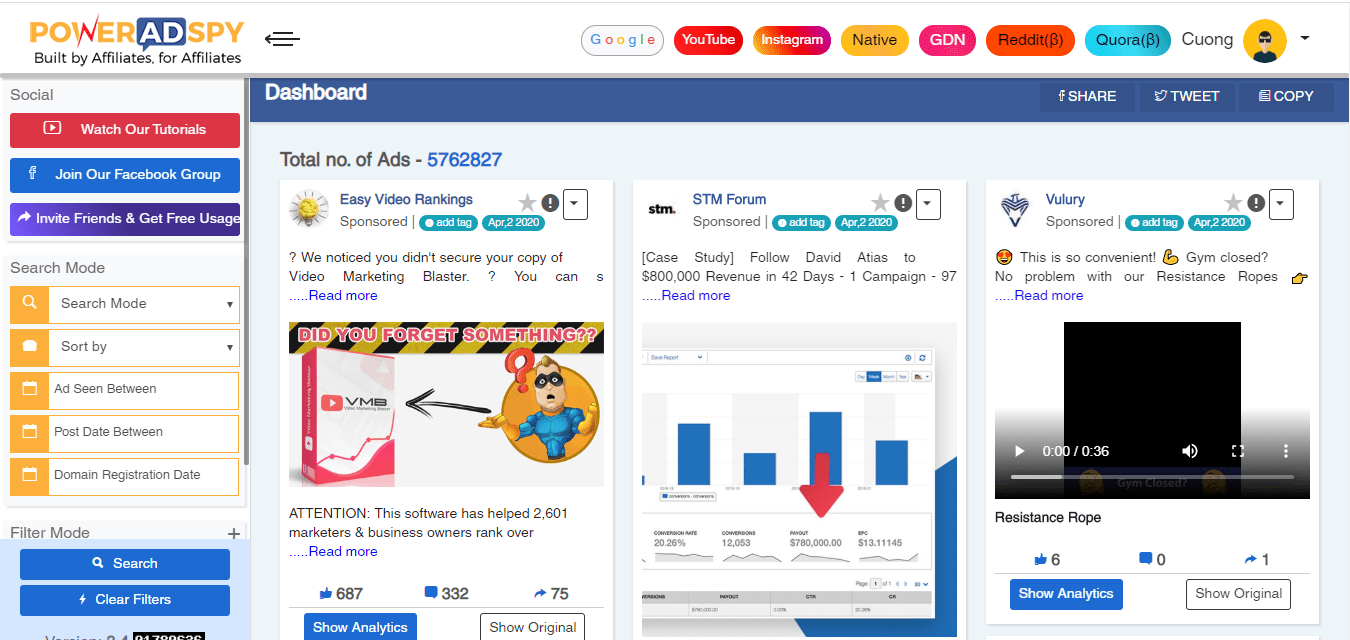
GetHookd Ads Library vs Facebook Ads Library
Gethookd vs Meta Ads Library
-
March 26, 2026

5 Insurance Facebook Ad Examples in 2026

Key Takeaways

  • Five Facebook ad formats are driving insurance results in 2026. Lead form quizzes, short videos, carousels, testimonials, and urgency ads each target different funnel stages.
  • Creative matters more than targeting now. Meta’s Special Ad Category limits audience targeting, so ad copy, visuals, and format do the heavy lifting.
  • High-performing ads focus on clarity and trust. Simple explanations, specific results (e.g., savings), and real customer stories improve engagement and conversions.
  • Conversion comes from intent and timing. Pre-qualifying leads, letting users self-select, and using deadlines help turn interest into action.
  • GetHookd helps media buyers and agencies research 65M+ ads across the Facebook Ad Library to find proven insurance ad concepts and generate testable creatives with AI.

What's Working for Insurance Advertisers on Facebook

The five insurance Facebook ad formats generating the strongest results in 2026 are lead form quiz ads, short video explainers, carousel comparison ads, customer testimonial ads, and urgency-driven enrollment deadline ads. Each format solves a specific problem: qualifying leads before they reach your pipeline, building trust through real customer outcomes, or creating time pressure around enrollment windows.

What all five share is a focus on creative quality rather than audience-targeting precision. Since Meta expanded its Special Ad Category to include all insurance products in January 2025, lookalike audiences, narrow age brackets, and ZIP code targeting are no longer available. 

That shift means your ad copy, visuals, and format selection now determine whether the right prospects stop scrolling and take action. Below is a breakdown of each format with examples of what makes them work.

GetHookd: Turn Competitor Intelligence Into Your Next Winning Ad

65M+ Ads Analyzed | 4.8★ G2 Rating | 4.5★ Trustpilot Rating

Stop Guessing. Start Scaling:

GetHookd reveals which ads your competitors are actively scaling—not just running. Spy on their best-performing creatives, landing pages, and traffic strategies, then turn proven concepts into testable campaigns in seconds with AI-powered script generation and creative cloning.

What You Get:
  • ✓ Brand Spy to decode competitor ad strategies in real-time
  • ✓ AI script generation and ad cloning for instant variations
  • ✓ Performance scoring based on actual ad behavior, not vanity metrics
  • ✓ Creative Analyzer to identify and scale your top performers
Replace guesswork with intelligence. Build profitable ads that actually convert.

5 Insurance Facebook Ad Formats That Convert

1. The Lead Form Quiz Ad

This format uses Facebook's native lead-generation objective, paired with a quiz-style form. Instead of asking users to fill out a generic contact form, the ad frames the process as a quick self-assessment. A typical headline reads something like: "Answer 3 questions to see if you're overpaying for coverage."

The quiz approach works because it reduces friction. Users feel they're getting a personalized answer rather than having to hand over their information. The best-performing versions include two or three qualifying questions, such as "Are you a homeowner?" or "What type of coverage are you looking for?" These pre-qualifiers filter out low-intent leads and improve close rates for agents who follow up.

The ad creative is usually a clean, single-image with bold text overlay and a "Get Started" CTA button. Keep the copy focused on a single question or pain point rather than listing multiple services.

2. The Short Video Explainer

Video ads under 45 seconds are among the strongest performers in the insurance vertical on Facebook. These typically explain a single concept, such as changes to Medicare Advantage plans for 2026, or a breakdown of how much term life insurance costs per day.

The most effective versions follow a tight structure. They open with a problem or fear-based hook in the first three seconds ("Most families don't realize how much a funeral costs in 2026"). The middle section delivers a clear, simple explanation. The close ends with a single call-to-action, usually a link to get a free quote or schedule a call.

Subtitles are a must. A large share of Facebook users watch videos with the sound off, and subtitled insurance explainers consistently outperform those without captions. Agents who use on-camera footage tend to build trust faster than those relying on stock animation.

A subtitled Facebook video ad walks viewers through a single insurance topic in under 45 seconds, using the hook-explanation-CTA structure that drives engagement in the insurance vertical. 

3. The Carousel Comparison Ad

Carousel ads let insurance brands showcase multiple policy options or coverage tiers in a single ad unit. Each card in the carousel highlights a different plan, with a short benefit statement and a CTA linking to a dedicated landing page.

This format is especially effective for health insurance brokers or agencies offering auto, home, and life bundles. A carousel might show three cards: "Auto Coverage from $XX/mo," "Home Protection Made Simple," and "Life Insurance for Less Than Your Daily Coffee." Each card carries its own image and link.

The strength of carousels is that they let users self-select based on their needs. Someone scrolling past an auto card might stop on the life insurance card and click through. This passive filtering mimics the effect of demographic targeting that Meta's Special Ad Category restrictions have removed.

4. The Customer Testimonial Ad

Social proof remains one of the most reliable conversion drivers in insurance advertising. Testimonial ads feature a real customer story, either as a short quote overlaid on an image or as a brief user-generated video.

A common structure for the copy reads: "I saved $480/year by switching my homeowner's policy. The whole process took 10 minutes." The visual pairs a photo of the customer (or a representative lifestyle image) with a headline that highlights the specific result.

What separates strong testimonial ads from weak ones is specificity. Vague claims like "great service" don't move the needle. Numbers, timelines, and concrete outcomes ("10 minutes," "$480/year") are what stop the scroll. 

Insurance brands that collect short video testimonials from satisfied clients have an advantage here, as video testimonials outperform static versions in engagement and conversion rate.

A testimonial-style Facebook ad highlights a specific dollar amount and timeline from a real customer, using measurable social proof to build trust with prospective policyholders.

5. The Urgency & Enrollment Deadline Ad

Insurance has natural deadline-driven moments throughout the year. Open enrollment periods for health insurance, Medicare Annual Enrollment (October 15 to December 7), and storm-season windows for homeowner's coverage all create built-in urgency.

These ads pair a bold countdown-style visual with direct copy: "Open Enrollment ends in 7 days. Don't miss your chance to lock in coverage." The CTA is usually "Enroll Now" or "Get Your Free Quote Before [Date]." The image often uses a clock, calendar, or countdown graphic to reinforce the time pressure.

The urgency format works because insurance is a category where procrastination is common. People know they need coverage, but delay action until a deadline forces their hand. These ads perform best when launched 7 to 14 days before a key enrollment window closes.

Top 5 Insurance Facebook Ad Examples: Summary Table

Ad Format Best For Key Element CTA Style
Lead Form Quiz Auto, health, life insurance Pre-qualifying questions in native form "Get Started" / "See My Results"
Short Video Explainer Medicare, life, and health insurance 45-second video with subtitles "Get a Free Quote" / "Schedule a Call"
Carousel Comparison Multi-line agencies and brokers Multiple coverage options in one ad "View Plans" / "Compare Now"
Customer Testimonial All insurance types Specific dollar savings or timeline "See How Much You Save"
Urgency/Enrollment Deadline Health, Medicare, homeowner's Countdown visual with deadline copy "Enroll Now" / "Lock In Coverage"

How GetHookd Helps You Build Better Insurance Ads

GetHookd's platform displays searchable ad results from its 65M+ database across the Meta Ad Library, filtered by niche, format, and engagement signals.

At GetHookd, we built our platform for media buyers, agencies, and performance marketers who need to move from research to ready-to-test creatives without wasting time or budget. Our database includes over 65 million ads across the Facebook Ad Library and Meta platforms, and we help you find the insurance ad concepts that are already converting.

With our Brand Spy feature, you can track any insurance brand's ad activity and see which creatives they are actively scaling. Our AI-powered tools then let you transcribe winning video ads, generate new hooks and scripts, and clone static ad variations in minutes. For insurance advertisers operating under Meta's tighter restrictions, the fastest path to better results is to build on concepts that already work.

Start your GetHookd free trial today!

Frequently Asked Questions (FAQs)

Do insurance ads on Facebook require a Special Ad Category?

Yes. Since January 2025, Meta has required all insurance-related ads to be classified under the "Financial Products and Services" Special Ad Category. Failing to select this category can result in ad rejection or account suspension.

What type of Facebook ad works best for life insurance?

Short video explainer ads and testimonial ads tend to perform strongest for life insurance. Video ads that address cost misconceptions or highlight simple application processes reduce buyer hesitation and drive quote requests.

How long should an insurance video ad be on Facebook?

Keep insurance video ads under 45 seconds. The first three seconds should feature a strong hook, and the entire video should focus on one benefit or pain point. Always include subtitles for sound-off viewers.

Can I target specific age groups with insurance Facebook ads?

Meta's Special Ad Category rules restrict age targeting to a broad 18 to 65+ range for insurance campaigns. You can no longer target narrow age brackets, so your ad copy needs to attract the right audience through messaging rather than demographic filters.

How does GetHookd help with insurance ad research?

GetHookd gives you access to 65M+ ads across the Meta Ad Library, with filters for niche, format, and engagement. Our Brand Spy shows which insurance ads competitors are scaling, and our AI tools let you generate scripts, clone creatives, and build new ad variations from proven concepts.

*Note: Pricing and/or product availability mentioned in this post are subject to change. Please check our website for current pricing and stock information before making a purchase.
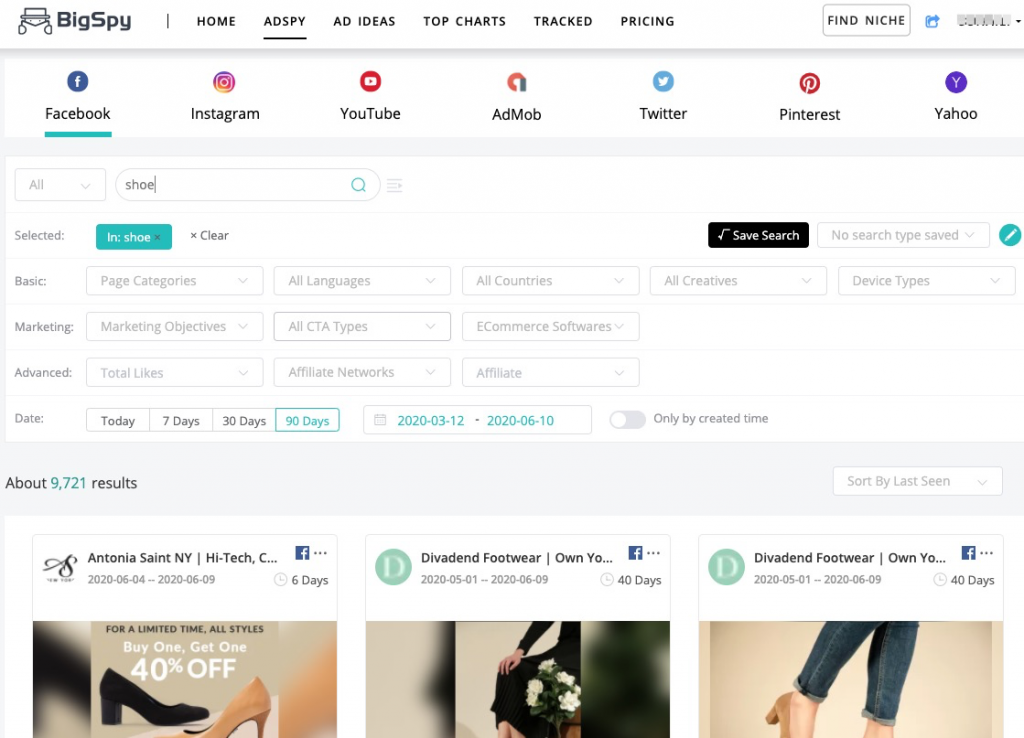
GetHookd Ads Library vs Facebook Ads Library
Gethookd vs Meta Ads Library
-
March 25, 2026

3 Best Restaurant Facebook Ads Examples

Key Takeaways 

  • Facebook ads are one of the most cost-effective marketing tools for restaurants, allowing hyper-local targeting to reach hungry customers within miles of your location.
  • The best restaurant Facebook ads combine strong visuals, a clear offer, and urgency; without all three, your ad gets scrolled past.
  • Video ads consistently outperform static images in the Facebook feed, but a high-quality food photo with the right copy can still drive serious results.
  • GetHookd shows you what restaurant ads are already converting before you build your own. Use our 65M+ ad library and Brand Spy feature to research real competitor campaigns so you launch with proven angles, not assumptions.

Why Do Most Restaurant Facebook Ads Fail?

The three best restaurant Facebook ad examples worth studying right now come from Applebee's, Burger King (via Redberry Restaurants), and Deraliye, a Michelin-recognized restaurant in Istanbul. Each uses a different strategy: cultural identity, a clear price-deadline offer, and prestige-driven urgency. Each works for a specific reason.

Facebook lets restaurant owners put a targeted offer directly in front of someone who lives five minutes away and hasn't decided where to eat tonight. The problem is that most owners run ads without a clear strategy. Budget is rarely the issue. Strategy almost always is.

Below, we pull apart each ad and show exactly what made it work, so you can apply the same thinking to your own campaigns.

GetHookd: Turn Competitor Intelligence Into Your Next Winning Ad

65M+ Ads Analyzed | 4.8★ G2 Rating | 4.5★ Trustpilot Rating

Stop Guessing. Start Scaling:

GetHookd reveals which ads your competitors are actively scaling—not just running. Spy on their best-performing creatives, landing pages, and traffic strategies, then turn proven concepts into testable campaigns in seconds with AI-powered script generation and creative cloning.

What You Get:
  • ✓ Brand Spy to decode competitor ad strategies in real-time
  • ✓ AI script generation and ad cloning for instant variations
  • ✓ Performance scoring based on actual ad behavior, not vanity metrics
  • ✓ Creative Analyzer to identify and scale your top performers
Replace guesswork with intelligence. Build profitable ads that actually convert.

3 Best Restaurant Facebook Ads Examples

1. Applebee's: Selling a Regional Food Experience at an Accessible Price Point

Applebee's ran a Facebook ad promoting their limited-time Big Easy Menu starting at $11.99, tapping into the cultural appeal of New Orleans cuisine. (Image source: Meta Ad Library)

The ad copy, "Mentally in NOLA, physically at Applebee's", is doing clever positioning work. It sells a mini escape, borrowing the excitement of a beloved food city and making it accessible at a neighborhood price.

Why Anchoring a Menu to a Cultural Identity Drives Engagement

Food tied to a specific place or culture carries built-in emotional weight. New Orleans cuisine evokes indulgence, bold flavors, and celebration, associations that transfer directly to the menu being promoted. Applebee's doesn't need to describe every dish because "Big Easy" does the storytelling for them. The cultural shorthand communicates flavor, atmosphere, and experience in two words.

The $11.99 starting price removes the other major barrier. Pairing an aspirational food experience with an accessible price point is a sharp move; you get the feeling of something special without the special-occasion price tag. "Limited Time Only" adds urgency without feeling aggressive.

If your restaurant draws inspiration from a specific cuisine or region, anchoring your ad to that cultural identity gives your food a story that a plain menu photo never can.

2. Burger King (Redberry Restaurants): The Clear-Offer, No-Nonsense Format

Redberry Restaurants' Facebook ad format goes straight to promoting their product without any extras.  (Image source: Meta Ad Library)

Redberry Restaurants ran a Burger King Facebook ad promoting a Crispy Chicken Meal for $8.99 with three options: Classic, Spicy, or the new Deluxe, and a hard deadline. There's no storytelling, no emotional hook, no mystery. Just a clear product, a clear price, and a clear deadline. Sometimes that directness is exactly what converts.

Why Simple, Price-Led Ads Still Win in Fast-Casual

Not every restaurant ad needs to be clever. For fast-casual and QSR brands, the audience already knows who you are and what you serve. The decision isn't "should I try this restaurant." It's "is there a reason to go today?" A specific deadline answers that question instantly.

The three-option structure is also strategically effective. Giving buyers a choice between Classic, Spicy, or Deluxe creates a sense of personalization within a standardized offer. The customer isn't just accepting a deal; they're choosing their version of it, which increases psychological ownership before they've even placed an order. 

The hard deadline adds real urgency without manufactured scarcity. If your restaurant operates in the fast-casual space, test a simple product-price-deadline ad against more elaborate creative, you may find the straightforward version outperforms.

3. Deraliye Restaurant: Selling Prestige & Urgency to Travelers

Deraliye Restaurant ran a Facebook ad leading with their Michelin Guide recommendation and targeting tourists visiting Istanbul.  (Image source: Meta Ad Library)

Deraliye Restaurant ad doesn't mention a price, a discount, or even a specific dish. Instead, it sells status and urgency; this is a Michelin-recognized experience, and your trip is ending soon. That combination of prestige and a ticking clock works particularly well for high-value dining.

Why Authority Signals Outperform Discounts for Fine Dining

Fine dining operates on entirely different purchase psychology than casual restaurants. Diners aren't looking for the best deal; they're looking for the best experience. A Michelin Guide mention does more to persuade than any discount could, because it transfers third-party credibility directly to the restaurant. 

The diner doesn't have to take the restaurant's word for it; an independent authority has already validated the experience. The travel-specific urgency,  "before the end of your Istanbul trip", is equally powerful.

Unlike manufactured countdown timers, this deadline is real and personal. The tourist knows their window is closing, which shifts the decision from "maybe someday" to "now or never."  Video format reinforces the strategy by showing the atmosphere, plating, and service in motion, details that static images can't fully convey. 

If your restaurant has any third-party recognition, lead with that credential in your ads to attract higher-spending guests who value quality over price.

How Do You Apply These Restaurant Facebook Ad Strategies to Your Own Campaigns?

1. Match Your Ad Format to Your Goal

Start by deciding what you actually want the ad to achieve before you touch a single creative element. Are you trying to fill seats on a slow night? Drive reservations for a special occasion? Promote a new menu item? Each goal calls for a different format, targeting strategy, and call to action.

Here's a quick reference to match your goal to the right format:

  • Fill slow weeknights: Discount or limited-time offer ad with urgency-driven copy
  • Drive event bookings: Experience-focused ad targeting relationship status or job titles
  • Launch a new menu item: Short video or close-up photo with curiosity-driven copy
  • Acquire new customers: Free item offer ad targeted to people who haven't visited yet
  • Build brand awareness: Atmosphere or experience-based ad with emotional copy

2. Lead With Your Best Visual Asset

Your visual is the first thing someone sees, and in a crowded Facebook feed, you have roughly a second to stop the scroll. Don't lead with your logo, a generic stock photo, or a cluttered image of your full dining room. 

Lead with your absolute best-looking dish, your most dramatic kitchen moment, or your most atmospheric table setting. If you don't have professional photos yet, a smartphone shot in good natural light with a clean background will outperform a cluttered studio photo every single time.

3. Always Include a Specific Offer or Hook

Vague ads get ignored. "Come visit us for a great meal!" tells nobody anything useful. Every ad you run should have either a specific offer (free item, discount, limited-time deal) or a specific hook (a curiosity question, a bold claim, an emotional promise).

Look back at every example in this article; not one of them ran a generic "we're open, come eat" ad. Specificity is what makes people act.

Best Restaurant Facebook Ads Examples Summary Table

Company Ad Strategy Key Offer Unique Approach
Applebee's Cultural identity & emotional appeal Big Easy Menu starting at $11.99 (Limited Time) Ties menu to New Orleans culture to create an aspirational yet affordable dining experience
Burger King (Redberry Restaurants) Clear offer, no-nonsense format Crispy Chicken Meal at $8.99 with a hard deadline Simple product-price-deadline structure with three meal options to drive personalization
Deraliye Restaurant Prestige & urgency targeting travelers No discount; leads with Michelin Guide recognition Uses third-party authority and travel urgency ("before your trip ends") to attract high-spending diners

Create Winning Restaurant Facebook Ads With GetHookd

The restaurants filling seats consistently aren't the ones with the biggest ad budgets; they're the ones who know exactly what creative, offer, and audience combination works before they spend a dollar testing it. That's the intelligence GetHookd gives you. 

Search 65M+ real ads across Facebook and Meta. See what competing restaurants are running right now, which offers they're leading with, what visuals are stopping the scroll, and which hooks are driving reservations in your market. Use Brand Spy to go deeper on any competitor, then generate scripts and clone top-performing creatives directly inside the platform.

When you're actively running ads and testing offers, guessing is expensive. GetHookd is the decision-support tool that replaces guesswork with real data, so every campaign you launch is built on a foundation of what's already proven to convert.

Start your GetHookd free trial today!

Frequently Asked Questions (FAQs)

What type of Facebook ad works best for restaurants?

Single-image ads with strong offers drive immediate clicks and reservations. Short video ads showcasing food preparation outperform static for brand awareness. Retargeting ads deliver the lowest cost-per-conversion and remain the most underused strategy in local restaurant advertising.

Should I use food photos in my restaurant's Facebook ads?

Both, but strategically. High-quality photos work best for quick-action offers. Short videos of food being cooked or plated work best for awareness campaigns. If the budget allows only one format, invest in three to five exceptional dish photos first, then reinvest in video once those campaigns generate revenue.

How do I target local customers with restaurant Facebook ads?

Set location targeting to a 5–15 mile radius around your restaurant. Layer on demographics and dining-out behaviors matching your typical customer. For sharper results, upload your customer email list as a Custom Audience, then build a Lookalike Audience to find similar local users.

How can GetHookd help restaurant marketers build better Facebook ads?

GetHookd provides access to 65M+ real ads across Facebook, TikTok, and Google, searchable by niche, format, and performance signals. Brand Spy shows which offers and visuals competing restaurants are running right now, and you can generate scripts and clone winning creatives directly inside the platform.

*Note: Pricing and/or product availability mentioned in this post are subject to change. Please check our website for current pricing and stock information before making a purchase.
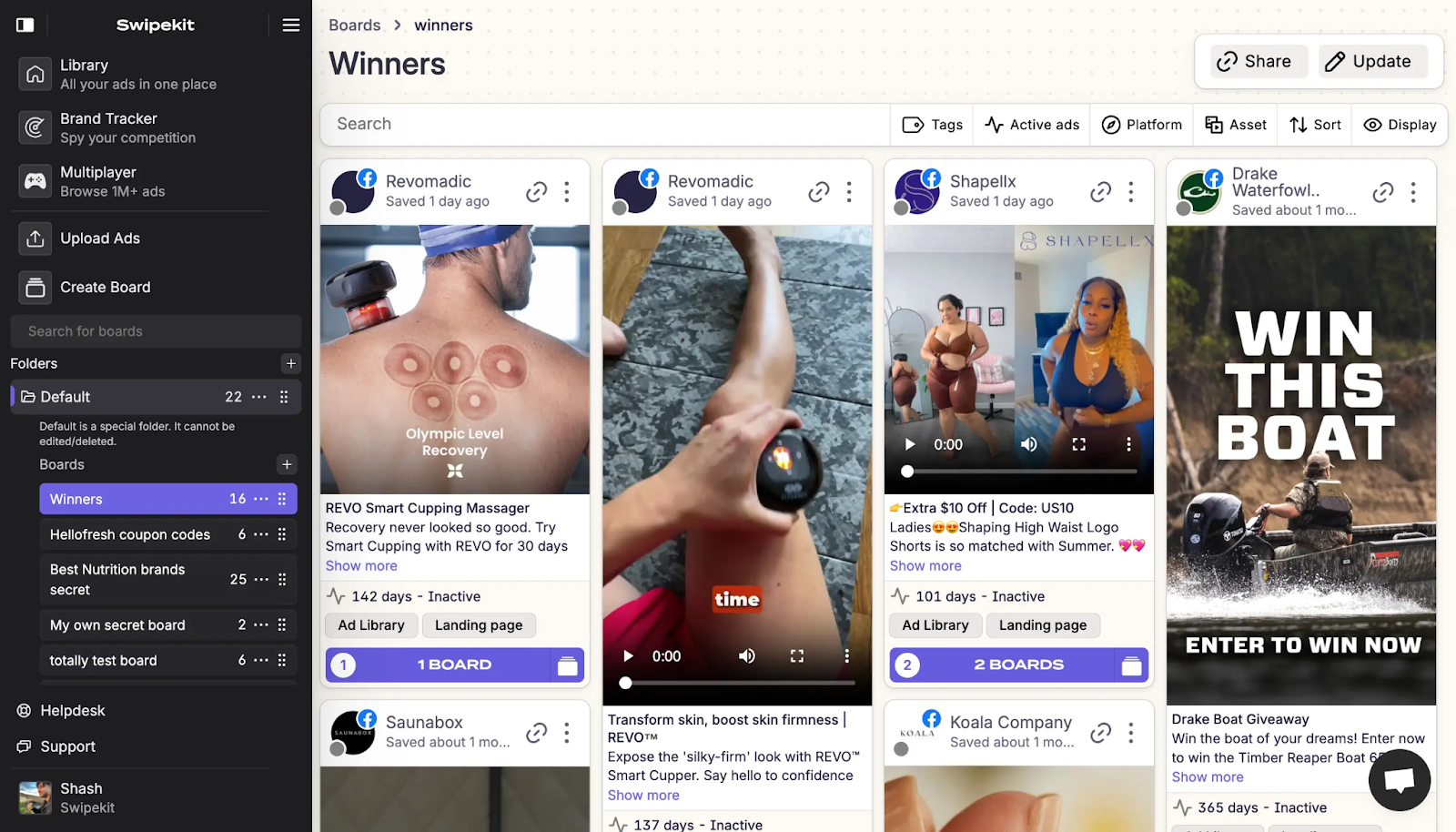
GetHookd Ads Library vs Facebook Ads Library
Gethookd vs Meta Ads Library
-
March 24, 2026

Car Dealer Facebook Ads: Examples & Tips

Article-At-A-Glance

  • Facebook ads give car dealerships access to highly specific audience targeting tools that most other platforms simply can't match.
  • Dynamic inventory ads deliver a higher click-through rate and drive more conversions than static ads, making them one of the most powerful tools in your arsenal.
  • There are three core ad formats every dealership should know, and choosing the wrong one can quietly drain your budget.
  • Small dealerships can compete directly with larger ones on Facebook with precise local targeting and tools that let any dealership research exactly what's working in their market right now.
  • GetHookd gives automotive marketers and small dealerships a competitive edge before launching any campaign. Instead of building car dealer Facebook ads from scratch, use GetHookd's 65M+ ad library and Brand Spy feature to research what competing dealerships are actively running.

Why Facebook Ads Beat Other Platforms for Car Dealerships

Facebook has become the most important digital marketing channel for marketers worldwide, and car dealerships are a big part of that story. With over 3.29 billion monthly active users as of late 2024, you're not broadcasting into the void; you're reaching real buyers while they scroll through their feeds.

What separates Facebook from platforms like Google or traditional media is its targeting precision. You can narrow your audience by location, age, household income, car ownership status, purchase intent, and even recent life events such as a new job or a move. That specificity means every dollar in your ad budget is working harder, something a billboard on the interstate simply cannot offer.

Many dealerships still aren't using Facebook ads to their full potential, which leaves a genuine competitive advantage open for those who do. Running smarter campaigns while your competitors run generic ones is one of the fastest ways to increase market share without increasing your overall marketing spend.

GetHookd: Turn Competitor Intelligence Into Your Next Winning Ad

65M+ Ads Analyzed | 4.8★ G2 Rating | 4.5★ Trustpilot Rating

Stop Guessing. Start Scaling:

GetHookd reveals which ads your competitors are actively scaling—not just running. Spy on their best-performing creatives, landing pages, and traffic strategies, then turn proven concepts into testable campaigns in seconds with AI-powered script generation and creative cloning.

What You Get:
  • ✓ Brand Spy to decode competitor ad strategies in real-time
  • ✓ AI script generation and ad cloning for instant variations
  • ✓ Performance scoring based on actual ad behavior, not vanity metrics
  • ✓ Creative Analyzer to identify and scale your top performers
Replace guesswork with intelligence. Build profitable ads that actually convert.

The Best Facebook Ad Formats for Car Dealerships

Facebook offers several ad formats, but not all of them are equally effective for automotive sales. The right format depends on where your buyer is in the purchase journey: awareness, consideration, or ready to buy.

Dynamic Inventory Ads Automatically Promote Your Stock

Dynamic inventory ads are the closest thing to a set-it-and-let-it-run solution in Facebook advertising. They automatically pull vehicles from your existing inventory feed and display them to users who have already shown interest, whether that's visiting your website, browsing similar vehicles on third-party platforms, or engaging with previous ads. 

The system matches the right vehicle to the right buyer at the right time without requiring you to manually create individual ads for every car on your lot.

For a dealership with a large or frequently rotating inventory, these ads should be the first format you test. They're especially powerful for retargeting, re-engaging shoppers who visited your site but didn't convert.

Lead Form Ads Capture Buyer Details Without Leaving Facebook

Lead form ads solve one of the biggest friction points in digital advertising: the click-away drop-off. Instead of directing a user to your dealership website, where they might get distracted or leave, lead ads present a pre-filled contact form directly inside Facebook. 

The user's name, email, and phone number are often auto-populated from their profile, making it a one-tap process to submit their information.

This format works exceptionally well for specific offers, trade-in valuations, test drive bookings, financing pre-approvals, and limited-time promotions. The lower the friction, the higher the conversion rate, and lead form ads are purpose-built around that principle.

Video Ads Drive Higher Engagement Than Static Images

Video ads outperform static images in engagement across nearly every industry, and automotive is no exception. A well-produced walk-around video of a featured vehicle, a time-lapse of a detailing job, or even a simple testimonial from a recent buyer can stop a user mid-scroll in a way that a single photo rarely does. 

Facebook's algorithm also tends to reward video content with broader organic reach, which means your paid video ads often carry extra mileage.

You don't need a Hollywood budget to make effective video ads. Smartphone footage with good lighting and a clear message consistently outperforms over-produced content that feels like a traditional TV commercial. Authenticity performs on social media; a genuine walk-around of a 2023 Ford F-150 with real footage from your lot will outperform a generic stock video every time.

Car Dealer Facebook Ad Examples That Work

The "Before & After" Refurbishment Ad

This ad format shows a side-by-side comparison of a used vehicle before and after your service team worked on it. A scratched-up bumper transformed to showroom condition, a dull exterior brought back to life with a full detail, or a worn interior restored to near-new quality, these visuals do the convincing without any written claims. 

They demonstrate the quality of your reconditioning process without saying a word about it, and they build confidence among buyers who are skeptical about buying a used vehicle.

The "Car of the Week" Spotlight Ad

The Car of the Week format is a recurring campaign that highlights one featured vehicle each week with a dedicated ad. What makes this approach powerful is the consistency, buyers begin to look forward to the weekly feature, and it creates a pattern of regular engagement with your dealership's Facebook presence. 

Over time, this builds an audience of warm followers who are already invested in what you're selling before they ever walk through the door.

The Virtual Test Drive Video Ad

A virtual test drive ad is a first-person or walk-around video that simulates the experience of being in and around the vehicle. Think interior shots from the driver's seat, a slow walk around the exterior highlighting key features, and a brief on-road clip if possible. 

This format bridges the gap between online browsing and the physical dealership experience, and it's especially effective for buyers who are still in the research phase and haven't committed to visiting a lot yet.

When a prospect has already "experienced" the car through a compelling video ad, they walk onto your lot with a level of pre-sold confidence that shortens the sales cycle. (Image source: Facebook)

3 Tips to Run a Successful Car Dealer Facebook Ad Campaign

1. Use High-Quality Photos of Your Actual Inventory, Not Stock Images

Stock photos are the fastest way to kill credibility in a car dealership Facebook ad. Buyers have seen the same generic showroom images recycled across dozens of dealer ads, and they've learned to tune them out completely. 

Real photos of real vehicles, your actual inventory, shot on your actual lot, create immediate authenticity and tell the buyer that what they're seeing is available right now.

2. Test Multiple Ad Formats to Find What Works for Your Dealership

The dealerships that outperform their competition on Facebook aren't necessarily running the most sophisticated campaigns. They're the ones who test systematically and let performance data make the decisions rather than gut instinct.

Start by running two or three different formats simultaneously with the same audience and budget allocation. A dynamic inventory ad, a lead form ad, and a single-image ad targeting the same used SUV buyer segment will give you direct, side-by-side performance data within the first two weeks. 

From there, you double down on what's converting and cut what isn't. That process compounds over time into a highly optimized, efficient ad account.

Introduce new creative variations within your top-performing format to test headlines, images, and CTAs. Never stop testing, audiences change, inventory changes, and seasonal factors shift performance constantly.

3. Rotate Ads Regularly to Avoid Audience Fatigue

Ad fatigue is one of the most common and most costly mistakes dealerships make on Facebook. When the same creative runs to the same audience for too long, engagement drops, cost per click rises, and the algorithm starts deprioritizing your ads in favor of fresher content from other advertisers. 

The rule of thumb is to refresh your creative every 3 to 4 weeks, or sooner if you notice your click-through rate falling or your cost per lead rising without a corresponding increase in lead quality. 

Rotating in new vehicle photos, updated headlines, or a different promotional angle is often all it takes to reset performance and re-engage your audience effectively.

Car Dealer Facebook Ads Examples Summary Table

Feature GetHookd Foreplay MagicBrief
Best For Media buyers, eCommerce brands, and agencies that need research, analytics, and ad production in one platform Creative strategists and agencies looking to build a library of ad inspiration Creative teams that need to save and storyboard ad ideas
Pre-Spend Competitive Intelligence Explore Ads and Brand Spy show what is converting in your niche and what competitors are actively scaling Search and save from a curated community library of ads Save ads from the Meta Ad Library and TikTok Creative Center
AI Creative Production Video Scripts, Clone Ads, and Ads Transcription Brief builder only Brief builder only
Ad & Funnel Templates Image Ad Templates and plug-and-play Funnel Templates Not available Not available
Ad Database 65M+ Meta ads Community-curated library User-saved ads only
Creative Analytics Creative Analyzer connects to Meta Business Manager to surface performance patterns Not available Basic insights
Starting Price $19/month $99/month $29/month

Drive More Car Sales With Smarter Facebook Ads Using GetHookd

The dealerships generating the most leads on Facebook aren't winning because of bigger budgets; they're winning because they know exactly what to do. That intelligence is what GetHookd delivers. For automotive marketers and agencies managing multiple dealership clients, or operators testing new inventory campaigns, GetHookd removes the trial-and-error phase that quietly drains ad budgets.

Search 65M+ real ads across Facebook to see what competing dealerships and automotive brands are actively running. Use Brand Spy to uncover their top-performing creatives, offers, and landing pages, then build your own campaigns with certainty rather than assumptions. Generate scripts and clone winning ad variations directly inside the platform without the guesswork or wasted spend.

Start your GetHookd free trial today!

Frequently Asked Questions (FAQs)

What type of Facebook ad works best for car dealerships?

Dynamic inventory ads consistently deliver strong performance for dealerships with an active inventory feed, with higher engagement and conversion rates than static ads in most reported cases. That said, the best format depends on your goal. 

Can small dealerships compete with large ones on Facebook?

Yes, and often with a structural advantage. Facebook's targeting tools let any dealership reach exactly the right local buyers regardless of overall marketing budget. This precision targeting removes the structural advantage larger dealers have always relied on. Small dealerships can also move faster, testing new creative and updating offers without the approval layers that slow down larger organizations.

How long does it take for Facebook ads to generate car sales leads?

Most dealerships see initial lead activity within the first few days of launch, but lead quality and volume improve significantly over the first two to four weeks as Facebook's algorithm completes its learning phase. 
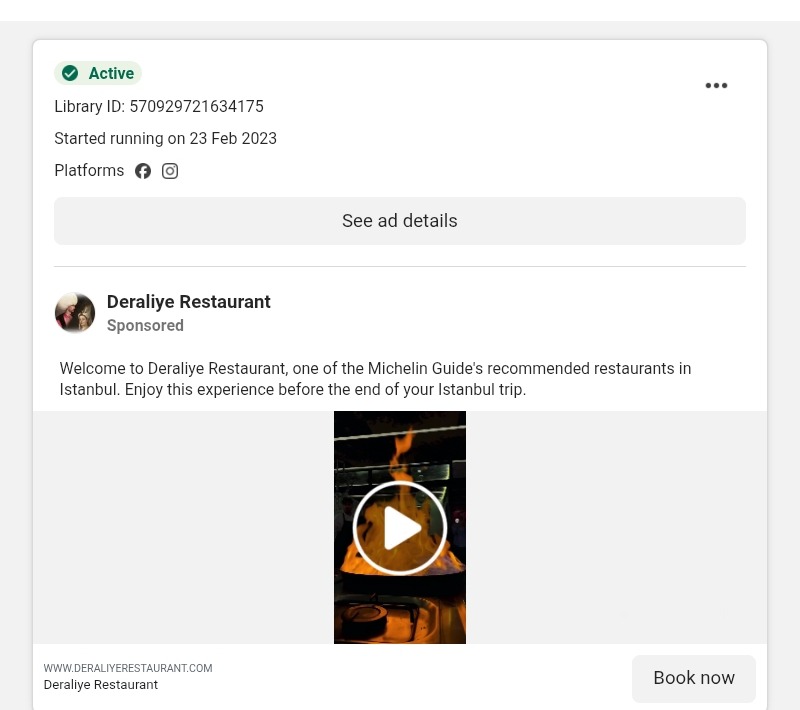
Expect the first two weeks to serve primarily as a data-collection and refinement period. By weeks three and four, the cost per lead typically starts to drop, and lead quality improves noticeably. A well-structured campaign should be producing a predictable, scalable lead flow by month two.

How can GetHookd help car dealership marketers build better Facebook ads?

GetHookd gives automotive marketers and agencies direct access to 65M+ real ads running across Facebook, searchable by niche, format, and performance signals. Use Brand Spy to see exactly what competing dealerships are running right now: which offers they're leading with, what creative formats they're using, and which landing pages they're sending traffic to. 

From there, generate scripts and clone top-performing ad variations directly inside the platform, so every campaign you launch is grounded in proven competitive intelligence rather than guesswork.

GetHookd Ads Library vs Facebook Ads Library
Gethookd vs Meta Ads Library
-
March 23, 2026

4 Best Gym Facebook Ads Examples for 2026

Key Takeaways 

  • Emotion-led ads consistently outperform appearance-based fitness ads: inclusivity messaging, like Planet Fitness's "Strength feels easy here" campaign, resonates more deeply with cold audiences.
  • The best gym Facebook ads match format to goal: video for equipment, lead ads for memberships, carousel for showcasing class variety.
  • Seasonal urgency, giveaways, and free trials are proven levers that top gyms use to reduce friction and spike sign-ups fast.
  • Instead of guessing which gym ad angles convert, use GetHookd's 65M+ ad library and Brand Spy feature to research real competitor campaigns, then build your own with data behind every decision.

The Gym Facebook Ads That Actually Work in 2026

The best gym Facebook ads for 2026 lead with emotion, not equipment. Planet Fitness, CrossFit, PureGym, and Ninja Nation Austin each run campaigns built around a single psychological trigger like belonging, community, convenience, or family. Because these signals resonate so deeply, they consistently outperform feature-packed alternatives. Ultimately, cutting through the feed requires a clear offer, a specific audience, and creative that makes the viewer feel something.

Below are the best gym Facebook ad examples broken down by format, psychology, and exactly how you can replicate them for your own fitness business. Each one works for a different reason, and each one teaches a lesson you can apply immediately, regardless of your ad budget.

GetHookd: Turn Competitor Intelligence Into Your Next Winning Ad

65M+ Ads Analyzed | 4.8★ G2 Rating | 4.5★ Trustpilot Rating

Stop Guessing. Start Scaling:

GetHookd reveals which ads your competitors are actively scaling—not just running. Spy on their best-performing creatives, landing pages, and traffic strategies, then turn proven concepts into testable campaigns in seconds with AI-powered script generation and creative cloning.

What You Get:
  • ✓ Brand Spy to decode competitor ad strategies in real-time
  • ✓ AI script generation and ad cloning for instant variations
  • ✓ Performance scoring based on actual ad behavior, not vanity metrics
  • ✓ Creative Analyzer to identify and scale your top performers
Replace guesswork with intelligence. Build profitable ads that actually convert.

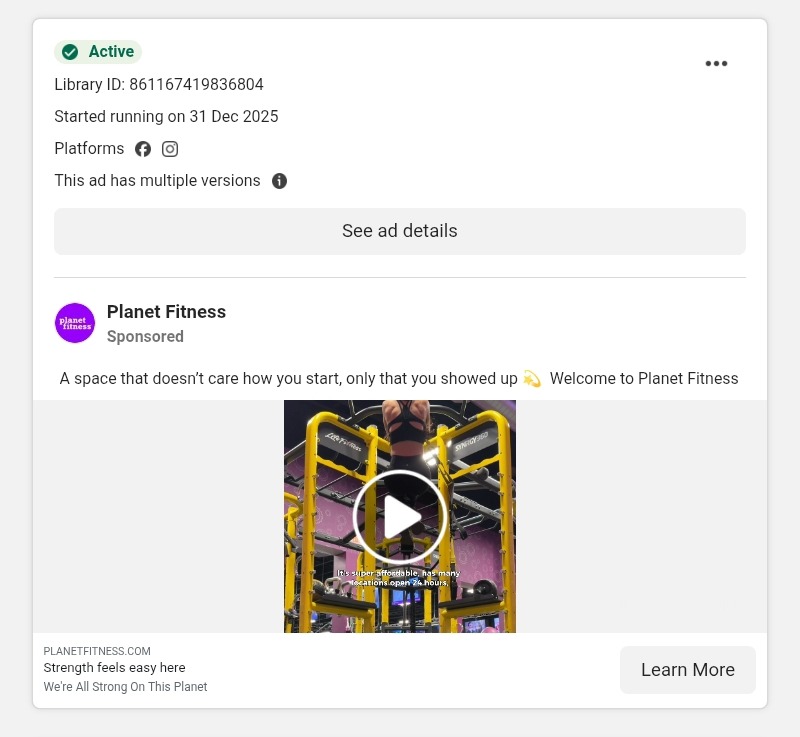
4 Best Gym Facebook Ads Examples for 2026

1. Planet Fitness: The Judgment-Free Welcome Ad

Planet Fitness leads with emotional safety over gym features, a strategy that consistently outperforms traditional fitness advertising on social media. (Image source: Meta Ad Library)

Planet Fitness ran a Facebook ad with a simple but powerful message: "A space that doesn't care how you start, only that you showed up." Paired with video content and an inclusivity-focused tagline, the ad directly targets people who feel intimidated by traditional gym culture. There's no mention of equipment, classes, or pricing, just an emotional invitation.

Why Removing Intimidation Is the Strongest Gym Ad Strategy

Most people avoiding the gym aren't lazy; they're self-conscious. Planet Fitness addresses that barrier head-on by making the ad about showing up, not performing. "We're All Strong On This Planet" reinforces that everyone belongs at every fitness level. This messaging speaks to a far larger audience than any transformation photo because it includes people who haven't started yet, the exact audience most gyms fail to reach.

How to Replicate This Welcoming Approach for Your Gym

You don't need a national brand to run this strategy. Film real members at various fitness levels, write copy that acknowledges the hesitation, and lead with belonging over results. A line like "No one's watching. Everyone's rooting for you" will drive more sign-ups than any before-and-after photo. Lead with empathy, follow with your offer.

2. CrossFit: The New Year Community-Driven Ad

CrossFit's resolution-season ad keeps the creative short and the CTA frictionless; one message, one action, zero distractions. (Image source: Meta Ad Library)

CrossFit ran a short, punchy video ad timed to New Year's resolutions with one clear message: "Your new year's goals start at a CrossFit gym surrounded by people who want to see you succeed." The CTA drives directly to a gym locator. No pricing, no giveaway, just a community promise paired with a seasonal motivation trigger. To see what seasonal gym ads are actively running in your market right now, GetHookd's Brand Spy shows you exactly that

Why Community Messaging Converts Better Than Discount Offers

People abandon New Year's fitness goals because they try alone. CrossFit's ad speaks directly to that failure point by positioning the gym as a support system, not just a facility. "Surrounded by people who want to see you succeed" reframes the gym from a place you go to a community you join. That distinction is what turns a January signup into a year-round member.

How Seasonal Timing Amplifies a Simple Message

New Year's resolution content has a narrow but powerful window. CrossFit doesn't waste it on complicated offers; they pair the moment with a single emotional hook and a frictionless next step. The gym locator CTA is critical: it converts motivation into action immediately. If your gym runs resolution-season ads, keep the message singular and make the path from ad to signup as short as possible.

3. PureGym US: The Convenience-First Accessibility Ad

Three words do all the selling. PureGym builds its entire ad around removing the most common barrier to gym attendance: scheduling. (Image source: Meta Ad Library)

PureGym US ran a Facebook video ad built entirely around one message: "Now Open 24/7." The supporting copy, "Train Anytime. Feel Good Every Time" and "Gym when you want" reinforces that the core selling point is unrestricted access. No pricing, no class schedules, no trainer profiles. Just convenience as the entire value proposition.

Why Convenience Beats Features in Gym Advertising

One of the most commonly cited reasons people skip the gym is schedule conflict. PureGym's ad eliminates that objection entirely with three words. "24/7" carries the entire message: it tells shift workers, parents, early risers, and night owls that this gym fits their life, not the other way around. When your biggest competitive advantage is accessibility, let that single point dominate your creative instead of diluting it with secondary messages.

How a Single Selling Point Creates a Stronger Ad

PureGym could have listed equipment, classes, pricing, and locations. Instead, they repeated one idea three ways: "Now Open 24/7," "Train Anytime," "Gym when you want." That repetition doesn't feel redundant; it feels reassuring. For gyms with a clear structural advantage like 24/7 access, no contracts, or no joining fees, building your entire ad around that single point will outperform a cluttered creative every time.

4. Ninja Nation Austin: The Activity-Packed Family Entertainment Ad

Ninja Nation targets parents solving a summer problem, not fitness enthusiasts chasing a goal, a subtle but powerful audience reframe. (Image source: Meta Ad Library)

Ninja Nation Austin ran a Facebook video ad promoting their new ninja warrior obstacle course gym, targeting families during summer with a heat-escape angle. The ad lists everything from open gyms and classes to summer camps, birthday parties, and team building, positioning the facility as a multi-purpose family destination rather than a single-use gym.

Why the "Escape the Heat" Hook Works for Family Fitness

Parents during summer aren't searching for fitness; they're searching for ways to keep kids active and entertained indoors. "Take a break from the HEAT and come play at Ninja Nation" reframes an obstacle course gym as the answer to a parenting problem. That contextual hook outperforms promoting the gym's features in isolation, because it meets the audience where their heads already are.

When Listing Everything Works Better Than a Single Offer

Most ad advice says focus on one message. Ninja Nation breaks that rule effectively because its audience needs to see breadth. A parent considering a summer activity wants to know that there are camps, parties, classes, and open gym; each option serves a different need and a different visit occasion. 

For multi-service facilities targeting families, showing the full menu of options signals value and versatility that a single-offer ad can't communicate. The key is formatting the list cleanly so it scans in seconds, exactly what Ninja Nation's bullet-point structure achieves.

Which Gym Facebook Ad Strategy Should You Use?

Company Ad Strategy Key Offer Unique Approach
Planet Fitness Emotion-led inclusivity messaging Open invitation to join with no performance pressure Removes gym intimidation by leading with belonging over results, targeting people who have not yet started their fitness journey
CrossFit Community-driven seasonal ad Free gym locator CTA directing users to a nearby CrossFit location Pairs New Year's resolution timing with a community promise rather than a discount, positioning the gym as a support system
PureGym US Convenience-first single selling point 24/7 unrestricted gym access Repeats one core message three ways to reassure shift workers, parents, and night owls that the gym fits their schedule
Ninja Nation Austin Family entertainment and activity destination Open gyms, classes, summer camps, birthday parties, and team building Reframes an obstacle course gym as the solution to a summer parenting problem rather than a fitness facility

Run Smarter Gym Facebook Ads With GetHookd

Every ad in this list works for the same underlying reason: it is built around one specific emotional trigger aimed at one specific audience, with nothing to dilute the message. Belonging for Planet Fitness. Community for CrossFit. Convenience for PureGym. Family problem-solving for Ninja Nation. That is the pattern. Pick your angle, own it fully, and strip everything else out.

The harder part is knowing which angles are working right now in your specific market — and that is where research replaces guesswork. GetHookd is the decision-support layer that tells you what is already converting before you spend a dollar finding out the hard way. Whether you are a gym owner, a media buyer running campaigns for multiple fitness clients, or an agency managing gym accounts at scale, GetHookd removes the guesswork from every creative decision.

Start your GetHookd free trial today!

Frequently Asked Questions (FAQs)

What type of Facebook ad works best for gyms?

Facebook Lead Ads consistently perform best for gyms focused on generating new memberships, since the native form keeps prospects inside the platform and reduces drop-off. For brand awareness, video ads featuring real members and real workouts perform strongest. The right format always depends on your specific goal.

Do gym Facebook ads work better with video or static images?

Both formats have a place, but they serve different purposes. Video is better for conveying atmosphere, community, and the feeling of being inside your gym. Static images are better for direct-response offers where speed of comprehension matters most. A polished single-image ad with strong copy will always outperform a poorly produced video. Prioritize quality over format when resources are limited.

How do I reduce the cost per lead on gym Facebook ads?

Use a low-commitment offer: a free class, a free week pass, or a no-obligation tour, to lower entry resistance. Keep your lead form short, asking only for name, email, and phone. Pair your Lead Ad with an automated CRM follow-up that contacts new leads within five minutes of form submission. Most gyms lose leads not because their ads are weak, but because their response time is too slow.

How can GetHookd help gym marketers build better Facebook ads?

GetHookd gives gym marketers and fitness advertisers direct access to 65M+ real ads running across Facebook and Meta, searchable by niche, format, and performance signals. Use the Brand Spy feature to see exactly what competing gyms and fitness brands are running, which offers they're leading with, and what creative angles are getting traction right now. 

Then generate scripts and clone ad variations directly inside the platform, so you spend less time researching, and more time launching creatives that have already proven to work.